

If you’ve been living with joint pain, a slow-healing injury, or a degenerative condition, you’ve probably heard the term stem cell therapy more than once. But understanding what is stem cell therapy, and separating real clinical applications from overpromised marketing claims, is genuinely difficult. This guide breaks down how stem cells work, which conditions they can realistically address, how the therapy compares to treatments like PRP, and what you should know about safety and cost before taking any next steps.
Table of Contents
- Key takeaways
- What stem cells actually are
- Clinical applications for pain and injury
- How stem cell therapy differs from PRP
- Safety, regulation, and cost in 2026
- How to evaluate your options as a patient
- My perspective on where stem cell therapy actually stands
- Explore regenerative care at Nortex Tissue Regeneration
- FAQ
Key takeaways
| Point | Details |
|---|---|
| Stem cells are unique cells | They can differentiate into specialized tissue types, which is what makes them therapeutically relevant. |
| FDA approval is narrow | Only hematopoietic stem cell transplantation holds full FDA approval; most orthopedic applications remain investigational. |
| PRP is not stem cell therapy | The two treatments work through entirely different mechanisms and are suited to different conditions and stages. |
| Cost varies significantly | Autologous treatments typically run $3,000 to $12,000; some advanced experimental protocols exceed $35,000. |
| Provider verification matters | Choosing a qualified, evidence-based clinic is the most important decision you will make in this process. |
What stem cells actually are
Most people have a general sense that stem cells are special. Fewer understand exactly why. Stem cells are immature cells with the unique ability to divide and differentiate into more specialized cell types, such as cartilage, bone, or muscle tissue. Once a cell matures, it stops dividing. Stem cell therapy leverages this plasticity, directing undifferentiated cells toward damaged tissue to support repair.
There are several types of stem cells relevant to therapeutic use, and the distinction matters clinically.
- Hematopoietic stem cells (HSCs): Found in bone marrow and cord blood, these are blood-forming cells used in approved transplants for blood cancers and certain immune disorders.
- Mesenchymal stem cells (MSCs): Mesenchymal stem cells are found in bone marrow and fat tissue and are widely investigated for orthopedic treatments because they can develop into cartilage, bone, and connective tissue.
- Autologous cells: Harvested from the patient’s own body, which reduces immune rejection risk.
- Allogeneic cells: Sourced from a donor, such as umbilical cord tissue. These can be produced in larger quantities but introduce different risk considerations.
The source and type of stem cell determine how a therapy is prepared, what it can realistically do, and what risks are involved. Not all stem cell products are equivalent, and that distinction is one that many clinics gloss over in their marketing.
Clinical applications for pain and injury
The question most patients care about is whether stem cell therapy can help with their specific condition. The answer depends on what you have, how advanced it is, and what the research currently supports.

Stem cell therapy shows clinical benefit in moderate to advanced osteoarthritis, tendon tears, and disc-related back pain. The proposed mechanism is tissue regeneration rather than just symptom suppression. That is a meaningful difference. Most pain medications reduce discomfort without addressing the structural reason for it. Stem cell therapy, at least in theory and in growing clinical evidence, aims to rebuild damaged tissue over time.
Common stem cell therapy applications currently being studied or used include:
- Osteoarthritis of the knee, hip, and shoulder: Studies report improved function and reduced pain over multiple years in some patients, particularly when the degeneration is moderate rather than end-stage.
- Tendon and ligament injuries: MSC injections are being studied for conditions like rotator cuff tears and Achilles tendinopathy, where conventional rehabilitation has not produced full recovery.
- Intervertebral disc degeneration: Early research suggests that stem cell injections into damaged discs may slow deterioration and reduce pain, though this application is still largely investigational.
- Systemic conditions: Multi-dose intravenous allogeneic MSC therapies show promise for chronic systemic conditions, though they require further validation and careful management of coagulation risks.
An important note: the autologous stem cell therapy market is projected to exceed $22 billion globally by 2030, reflecting strong medical and commercial interest. But market growth does not equal regulatory approval. Most orthopedic applications remain experimental, which affects both what a provider can legally offer and what you should realistically expect.
Pro Tip: Ask any provider whether their specific stem cell protocol is FDA-approved, FDA-cleared, or investigational. Those three categories mean very different things, and you deserve a clear, direct answer before agreeing to treatment.
How stem cell therapy differs from PRP
This is where a lot of confusion enters the picture. Many patients come in after seeing ads or articles that seem to use PRP and stem cell therapy interchangeably. They are not the same.
| Feature | PRP (Platelet-Rich Plasma) | Stem Cell Therapy |
|---|---|---|
| What it contains | Concentrated platelets from your blood | Living stem cells capable of differentiation |
| Mechanism | Activates and supports existing cells | Introduces new cells to regenerate tissue |
| FDA status | Not FDA-approved for orthopedic use | HSCT is approved; orthopedic use is investigational |
| Typical cost | $500 to $3,500 per treatment | $3,000 to $20,000 or more |
| Best suited for | Early-stage degeneration, mild injuries | Moderate to advanced tissue damage |
| Recovery time | Minimal, often same-day | Varies by protocol |
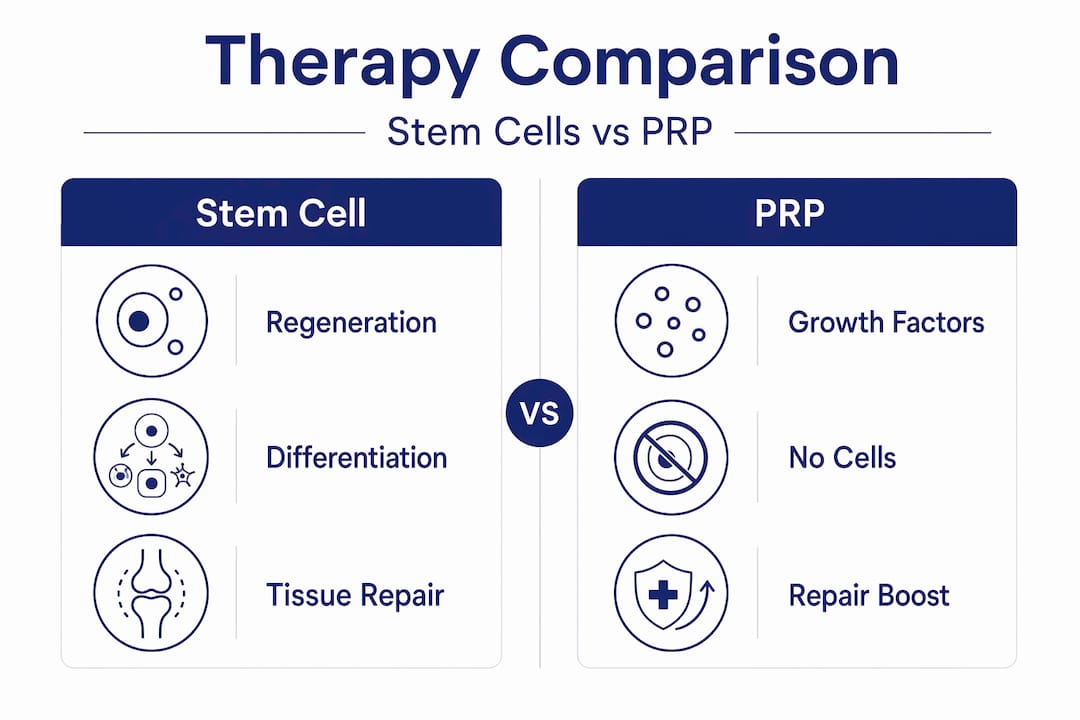
PRP contains no stem cells. It works by concentrating growth factors from your own blood and injecting them into a damaged area to stimulate the body’s existing repair response. That is genuinely useful for the right conditions. But it does not introduce new cells capable of building new tissue. You can read a more detailed breakdown of PRP versus stem cell therapy to understand which approach may be more appropriate for your situation.
True stem cell therapies deliver cells with the potential to differentiate and regenerate tissue. That biological distinction changes the treatment entirely, including the preparation, the source, the risk profile, and the cost. Neither therapy is superior in every context. The right choice depends on your diagnosis, the stage of your condition, and what evidence supports for your specific situation.
Safety, regulation, and cost in 2026
If you’re evaluating whether stem cell therapy is a realistic option, these are the three practical questions you need answered.
Regulatory status: The only FDA-approved stem cell therapy as of 2026 is hematopoietic stem cell transplantation, primarily for blood cancers and immune disorders. Nearly 25 stem cell-related therapies have some form of regulatory recognition globally, but the vast majority of musculoskeletal and pain applications remain experimental in the United States.
Safety considerations:
| Risk category | What to know |
|---|---|
| Infection | Any injection-based therapy carries a small risk of infection at the treatment site |
| Immune response | Allogeneic treatments carry a higher risk of immune reactions than autologous approaches |
| Coagulation effects | Transient hypercoagulability has been noted in some IV MSC protocols; anticoagulation strategies may be needed |
| Unproven clinics | Some facilities offer unapproved stem cell products with no clinical evidence; this is the most significant patient safety concern |
Cost ranges: Autologous stem cell treatments cost between $3,000 and $12,000, while allogeneic treatments typically range from $5,000 to $20,000. Lab-expanded MSC therapies in advanced experimental cases can exceed $35,000. PRP, by comparison, runs $500 to $3,500. Most insurance plans do not cover stem cell therapy for musculoskeletal conditions because these applications remain investigational.
Pro Tip: Before committing to any clinic, search the FDA’s database for adverse event reports related to their specific product or protocol. Legitimate providers will welcome your due diligence.
How to evaluate your options as a patient
If you’re seriously considering stem cell therapy, the most productive thing you can do is arrive at your consultation prepared. Here is a straightforward set of steps we recommend to patients exploring this path.
- Get a precise diagnosis first. Stem cell therapy is not appropriate for every pain condition. Knowing the exact source and severity of your issue, confirmed through imaging if necessary, is the foundation for any treatment decision.
- Ask about cell source and preparation. Is the therapy autologous or allogeneic? How are the cells processed and stored? What quality controls are in place? These are not overly technical questions. They are reasonable things to expect any qualified provider to answer.
- Request the evidence. Ask what clinical data supports the protocol being recommended for your specific condition. Published peer-reviewed studies, not testimonials, are the standard you should hold providers to.
- Understand the timeline. Stem cell therapy is not a quick fix. Many patients see gradual improvement over three to six months. Some see more substantial changes at the one-year mark. Others see limited benefit. Set your expectations before you start, not after.
- Explore the full picture. For many conditions, stem cell therapy for arthritis and joint pain is best understood as one option within a broader treatment plan that may include PRP, physical therapy, and lifestyle changes.
- Verify provider credentials. Work with a clinic that has board-certified physicians, transparent protocols, and a track record with regenerative medicine specifically, not just general practice.
My perspective on where stem cell therapy actually stands
I’ve spent a meaningful amount of time working with patients who come in after months or years of trying conventional options, hoping stem cell therapy will be the answer to everything. And I want to be honest with you: sometimes it makes a real difference. But it is not a cure, and the gap between what clinics advertise and what the science currently supports is still significant.
What I’ve observed is that patients who do best are those who come in with moderate, not end-stage, degeneration and who have realistic expectations about outcomes. A patient with early to moderate knee osteoarthritis who combines stem cell treatment with physical therapy and weight management often does far better than someone who expects a single injection to restore a severely degraded joint.
The field is also moving quickly. The therapeutic promise of stem cell plasticity is real, and multi-dose protocols are showing improved durability in early trials. But “promising” and “proven” are not interchangeable words. My honest take is that stem cell therapy deserves serious consideration for the right patient with the right condition, evaluated by a qualified provider using a transparent, evidence-informed protocol. That is a much more specific and honest framing than most of what you’ll find online.
— Felix
Explore regenerative care at Nortex Tissue Regeneration
At Nortex Tissue Regeneration, we work with patients across North Texas who are dealing with chronic joint pain, sports injuries, arthritis, and degenerative conditions. Our approach is non-surgical, evidence-based, and built around your specific diagnosis rather than a one-size-fits-all protocol. Whether you are exploring stem cell treatment options or want to understand whether PRP therapy is a better starting point for your condition, our team can walk you through what the current evidence supports and what makes sense for your situation. We also offer bone marrow cell therapy for patients who are appropriate candidates. Schedule a consultation at Nortex Tissue Regeneration to get a clear, honest picture of your options.
FAQ
What is stem cell therapy used for?
Stem cell therapy is used to treat blood cancers via FDA-approved hematopoietic transplantation, and is being investigated for musculoskeletal conditions like osteoarthritis, tendon injuries, and disc degeneration. Most orthopedic applications remain experimental as of 2026.
Is stem cell therapy safe?
Stem cell therapy carries real but manageable risks including infection, immune response, and in some IV protocols, transient coagulation effects. The most significant safety risk comes from unverified clinics offering unapproved products without clinical evidence.
How much does stem cell therapy cost?
Autologous treatments typically cost between $3,000 and $12,000, while allogeneic options range from $5,000 to $20,000. Advanced experimental protocols can exceed $35,000. Most insurance plans do not cover these treatments for musculoskeletal conditions.
What is the difference between stem cell therapy and PRP?
PRP uses concentrated platelets to stimulate your body’s existing repair response and contains no stem cells. Stem cell therapy introduces living cells capable of differentiating into new tissue. They have different mechanisms, costs, and appropriate use cases.
How long does it take to see results from stem cell therapy?
Most patients experience gradual improvement over three to six months, with some seeing more significant changes at the one-year mark. Results vary based on the condition being treated, the severity of degeneration, and the specific protocol used.