
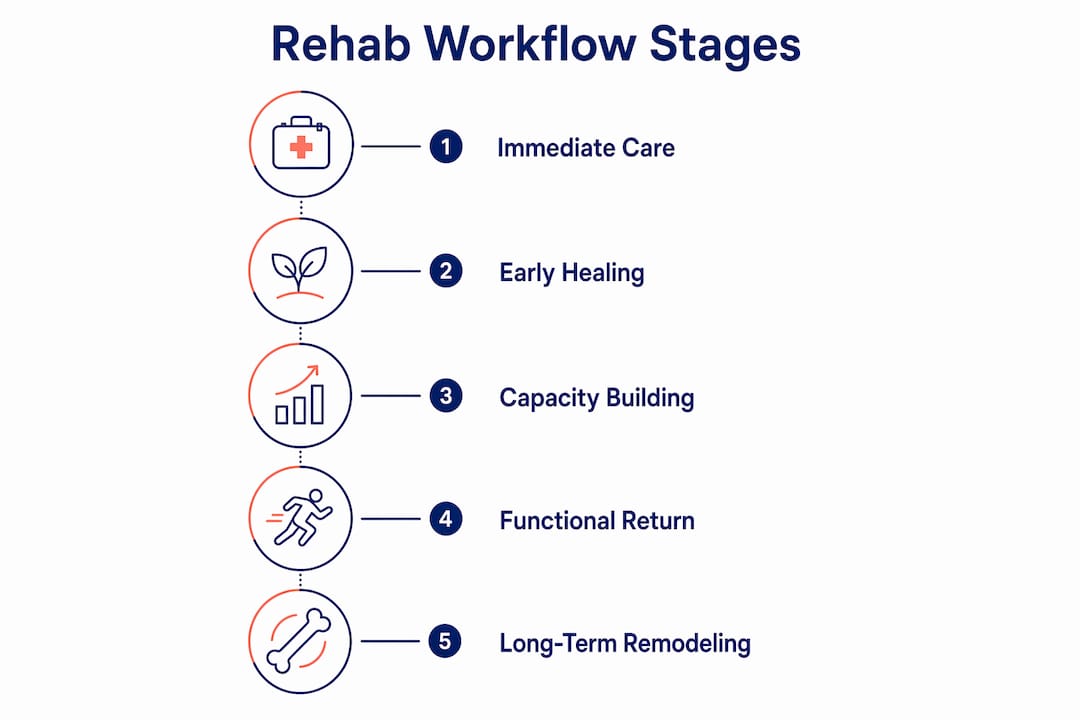
The rehab workflow after injury with regenerative medicine follows five structured phases, moving from immediate post-procedure protection through long-term tissue remodeling over 3–6 months. Unlike surgical recovery, this process works with your body’s natural healing cascade rather than around it. Most patients resume light daily activities within 48–72 hours, while full tissue repair extends over weeks to months.
Here is what the core workflow looks like:
- Immediate care (hours 0–48): Rest, elevate the treated area, avoid ice, and use acetaminophen only for discomfort
- Protection phase (weeks 1–4): Gentle movement, no NSAIDs, begin physical therapy within the first week
- Capacity building (weeks 4–8): Progressive loading at 50–75% effort, stationary bike, light resistance work
- Functional return (weeks 8–12+): Resume normal activity with provider clearance
- Long-term remodeling (months 3–6+): Tissue stabilization, lasting pain relief, and functional milestones
Pain flares in the first few days are normal and expected. They signal that the healing cascade has started, not that something has gone wrong.
What does the rehab workflow after injury actually look like, phase by phase?
Regenerative medicine recovery unfolds in biologically distinct stages. Understanding what is happening in your body at each point helps you stay patient and make better decisions about activity and rest.
Phase 1: Immediate post-treatment (hours 0–48)
Your body is responding to the introduction of concentrated healing factors. Mild soreness, swelling, and warmth at the injection site are all normal. Rest is the priority, though light walking to maintain circulation is encouraged. Avoid any strenuous activity that loads the treated joint or tissue.
Phase 2: Early healing (weeks 1–4)
Swelling typically resolves and pain begins to stabilize. Stem cells are differentiating and integrating into damaged tissue while growth factors signal the repair process to continue. Gentle physical therapy, usually starting within the first week, helps maintain range of motion without stressing the new tissue.

Phase 3: Capacity building (weeks 4–8)
This is when most patients first notice real functional change. Many patients begin to notice real functional changes during weeks 4–6 as tissue regeneration accelerates. Progressive loading can begin, but the “3/10 rule” applies: if pain exceeds a 3 out of 10 during exercise, or does not return to baseline within 24 hours, you have done too much.
Phase 4: Functional return (weeks 8–12+)
By weeks 7–12, patients often experience further pain reduction as stem cells fully integrate. Most normal activities, including recreational sports, become possible with minimal discomfort. Provider clearance is still required before returning to high-impact movement.
Phase 5: Long-term remodeling (months 3–6+)
Tissue maturation continues well past the point where you feel recovered. By six months, pain reduction is significant for many patients. Many patients report their best improvements between months four and six.
| Phase | Timeframe | Key focus |
|---|---|---|
| Immediate care | Hours 0–48 | Rest, no ice, acetaminophen only |
| Early healing | Weeks 1–4 | Gentle PT, no NSAIDs, protect the area |
| Capacity building | Weeks 4–8 | Progressive loading, 50–75% effort |
| Functional return | Weeks 8–12+ | Resume activity with clearance |
| Long-term remodeling | Months 3–6+ | Tissue stabilization, lasting relief |
Post-procedure care guidelines and what to realistically expect
Getting the aftercare right matters as much as the procedure itself. We see patients who do everything well in the clinic and then undermine their results in the first week at home.
The no-ice rule is one of the most misunderstood guidelines. Avoid ice for the first 72 hours after treatment. Ice causes vasoconstriction and suppresses the very inflammation your body needs to begin repair. After 48–72 hours, far-infrared heat for 20–30 minutes can improve circulation.
NSAIDs are the other major pitfall. Ibuprofen, naproxen, and aspirin block prostaglandins and platelet activation, which are the exact pathways regenerative treatments rely on. Acetaminophen is the appropriate choice for pain in the early weeks.
Key aftercare guidelines:
- Drink at least 64 oz of fluids daily to support plasma quality and cellular repair
- Prioritize 7–9 hours of sleep, since growth hormone releases primarily during deep sleep
- Eat a low-glycemic, protein-rich diet to provide the building blocks for collagen synthesis
- Avoid alcohol for at least 4–6 weeks post-procedure, as it impairs cellular repair
- Avoid smoking, which constricts blood vessels and limits stem cell function
Pro Tip: A majority of patients experience a pain flare in the first few days after treatment. This is not a complication. It is the biological transition from the inflammatory phase to the proliferation phase, and it typically resolves within a week. Knowing this in advance prevents unnecessary alarm and premature use of NSAIDs.
Physical therapy typically begins within the first week, focusing on gentle range-of-motion work. Moderate strengthening follows at weeks 4–6 once significant tissue regeneration is underway.
How regenerative rehab differs from traditional injury recovery
Traditional injury rehabilitation often defaults to immobilization first, then gradual reintroduction of movement. Regenerative medicine flips that sequence in important ways.
- Early guided mobilization, not immobilization. Modern regenerative rehab encourages movement early to prevent muscle atrophy and bone loss, provided it stays within pain-free limits.
- Treating the source, not the symptom. Regenerative medicine targets the underlying cause of pain rather than masking it with medication or removing tissue surgically. Functional improvement is the measure of success.
- Inflammation is an ally, not an enemy. Traditional rehab often uses ice and NSAIDs to suppress inflammation. In regenerative recovery, that same inflammation is the signal that recruits healing cells to the treatment area.
- Recovery is non-linear by design. Temporary aches and fluctuations signal the transition between the inflammatory and proliferation phases. A bad day on week three does not mean the treatment failed.
- Cellular growth is silent and fragile. Unlike surgical recovery, where pain provides feedback when you push too hard, regenerative recovery requires discipline even when you feel fine. Overloading the treated area too early can disrupt cell anchoring before it completes.
- Phase progression is criteria-based, not calendar-based. Moving from one phase to the next depends on functional benchmarks, pain scores, and range-of-motion assessments, not just how many weeks have passed.
Clinical insights from Nortextissueregeneration for a stronger recovery
What we’ve found, working with patients across a range of injuries and conditions, is that the patients who recover best are the ones who treat the protocol like a prescription, not a suggestion. The biology does not negotiate.
A few patterns we observe consistently:
- Patients who prepare before treatment with proper hydration, sleep, and nutrition tend to produce higher-quality PRP samples and respond more strongly to stem cell procedures.
- Recovery is rarely a straight line. Feeling worse on day five than day three is common and does not indicate failure. It usually means the body is transitioning between healing phases.
- Functional milestones matter more than pain scores alone. We track range of motion, strength, and activity tolerance at 4–6 weeks, 3 months, and 6 months to get a complete picture of progress.
- Many patients come in after trying cortisone injections or prolonged rest with limited results. Regenerative treatments work differently because they address the tissue itself, not just the symptoms.
Pro Tip: Collagen peptides taken 30–60 minutes before physical therapy sessions can help drive amino acids directly into joint tissue during the active regeneration phase. Pair this with adequate protein intake, targeting 1.6–2.0 grams per kilogram of body weight daily, to give your body the raw materials it needs.
Additional practices that support recovery:
- Integrate biologic injection guidance into your overall plan from the start
- Use aquatic therapy around week 3, when buoyancy allows weight-assisted movement without joint stress
- Track your own functional benchmarks between appointments so you can report meaningful changes to your provider
- Attend every follow-up visit. Adjustments to your activity plan are often made based on what your provider observes at these check-ins
Nortextissueregeneration offers a clear path forward without surgery
Patients who want to recover from injury without surgery, long downtime, or reliance on pain medications have a concrete option in North Texas. Nortextissueregeneration specializes in PRP therapy and stem cell treatments designed around the phased recovery workflow described throughout this article. Every treatment plan is personalized, evidence-based, and built to restore function, not just reduce pain temporarily. The clinic serves patients dealing with sports injuries, chronic joint pain, arthritis, and degenerative conditions. If you are ready to understand what your recovery could look like, contact Nortextissueregeneration to schedule a consultation and get a plan built around your injury and your goals.
FAQ
How long does the rehab workflow after injury take with regenerative medicine?
Most patients resume light activities within 48–72 hours. Full tissue repair and functional milestones extend over 3–6 months, with the most significant improvements typically occurring between months four and six.
Why can’t I use ice or NSAIDs after a regenerative treatment?
Ice causes vasoconstriction and NSAIDs block prostaglandins and platelet activation, both of which are required to initiate the body’s healing cascade. Suppressing that response directly undermines the treatment.
What is a pain flare and should I be concerned?
A pain flare in the first few days after treatment is a normal sign that the healing response has activated. About 60–70% of patients experience this, and it typically resolves within a week without intervention.
When does physical therapy start after a regenerative procedure?
Physical therapy generally begins within the first week, focusing on gentle range-of-motion work. Intensity increases at weeks 4–6 as tissue regeneration progresses and pain levels improve.
How does regenerative rehab compare to recovering from surgery?
Regenerative recovery typically involves less downtime, earlier mobilization, and no surgical risks. Up to 90% of patients see improvement with non-surgical regenerative options, avoiding the prolonged recovery associated with surgery.
Key Takeaways
The most effective injury rehabilitation workflow with regenerative medicine combines strict post-procedure protocols, phased activity progression, and functional milestone tracking over 3–6 months.
| Point | Details |
|---|---|
| No ice for 72 hours | Icing after treatment suppresses the inflammatory response needed for tissue repair. |
| Pain flares are normal | Many patients experience a flare in the first few days, signaling the healing cascade has started. |
| Pain reduction milestones | Most patients report 30–50% pain reduction by weeks 4–6, 50–75% by three months, and 70–90% by six months. |
| Criteria-based progression | Phase advancement depends on functional benchmarks, not just time elapsed since treatment. |
| Nortextissueregeneration | Offers personalized PRP and stem cell treatment plans in North Texas for injury recovery without surgery. |