

Stem cells are undifferentiated cells with the unique capacity to self-renew and differentiate into specialized cell types, making them the foundation of regenerative medicine’s most significant advances in 2026. The global stem cell therapy market is valued at approximately $20 billion this year, with projections to nearly triple by 2036. That growth reflects genuine scientific momentum, not just investor enthusiasm. From CRISPR-based purification platforms to the first human trials of partial cell reprogramming, the reasons why stem cells in 2026 represent a turning point in medicine are both specific and measurable.
Why stem cells in 2026 are redefining regenerative medicine
The most important shift in 2026 is that stem cells have moved well beyond simple tissue replacement. Yale Medicine researchers describe them as engines of discovery and personalized medicine, tools for immune modulation and disease modeling as much as for direct repair. This reframing matters for anyone evaluating treatment options, because it changes what you should realistically expect from a stem cell therapy.
Three cell types drive most of the current clinical activity. Hematopoietic stem cells (HSCs) have the longest track record, with FDA-approved use in blood cancers and immune disorders. Mesenchymal stem cells (MSCs) are the most common choice in orthopedic and pain-related applications. Induced pluripotent stem cells (iPSCs) represent the frontier, where patient-specific reprogramming is opening doors to personalized therapies with reduced immune rejection risk.

Understanding which cell type is being used in a given treatment, and why, is one of the most practical questions you can ask a provider.
What are the latest stem cell breakthroughs in 2026?
Three developments stand out this year as genuinely significant rather than incremental.
-
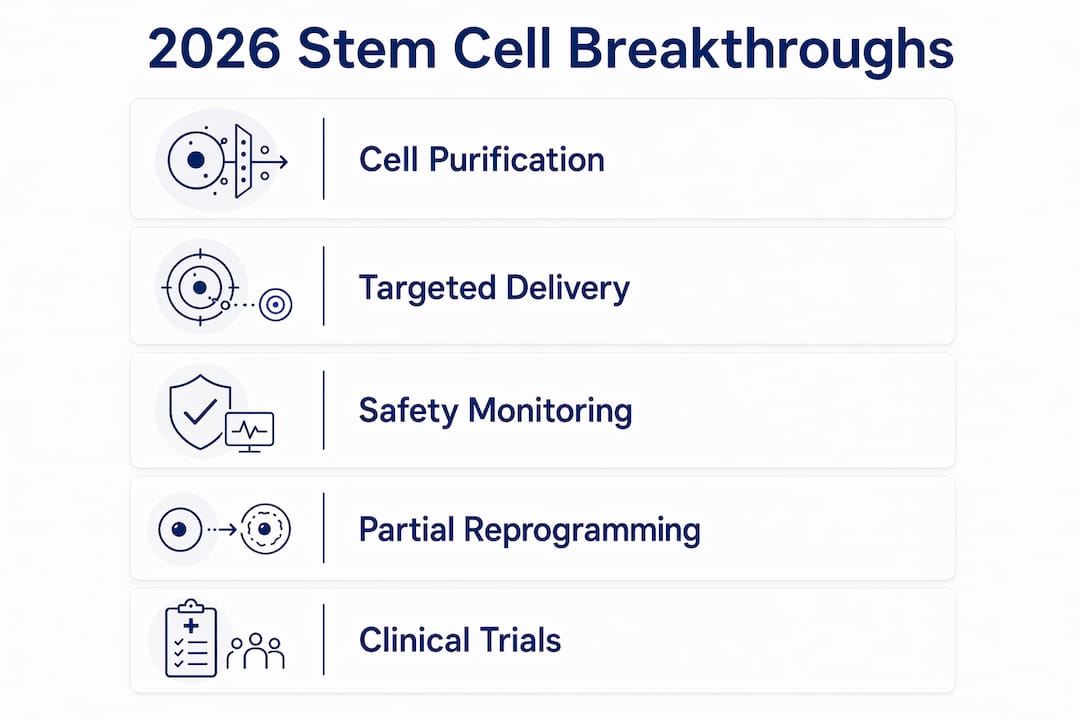
SMArT platform for gene-edited HSCs. The SMArT purification platform achieves 80 to 100% purity in CRISPR-edited human blood stem cells. That level of precision directly addresses one of the field’s most persistent safety concerns: the risk of off-target edits surviving in a mixed cell population. Higher purity means a cleaner, more predictable therapeutic product.
-
Partial cell reprogramming trials. In April 2026, the first human Phase I trials of partial cell reprogramming began, targeting age-related eye diseases using a 56-day activation protocol. These trials test whether cells can be rejuvenated without fully reverting to a pluripotent state, which would carry tumor risk. The results are not yet published, but the safety profile established here will shape the next decade of aging-related research.
-
Microrobot-assisted delivery. A June 2026 study from ETH Zurich demonstrated that microrobot-guided stem cell delivery in a mouse spinal cord injury model produced significant functional recovery within 28 days. The ability to place cells precisely at the injury site, rather than relying on systemic circulation, could change outcomes in neurological applications considerably.
Pro Tip: When evaluating any stem cell clinic or trial, ask specifically which cell type is being used, what the delivery method is, and whether the protocol follows Good Manufacturing Practice (GMP) standards. These three questions separate evidence-based care from unverified procedures.
What challenges and safety concerns still exist in stem cell therapy?
Progress is real, but so are the obstacles. A 2026 review published in Signal Transduction and Targeted Therapy identified key barriers to clinical translation including cell heterogeneity, poor standardization, immune rejection risk, and the difficulty of manufacturing at scale. These are not minor technical footnotes. They directly affect whether a therapy is safe and whether results can be reproduced across patients.
The practical risks worth understanding include:
- Immune reactions. Even autologous (your own) cells can trigger inflammatory responses depending on how they are processed and delivered.
- Tumor formation. Pluripotent cells carry a theoretical risk of uncontrolled growth if differentiation is incomplete. This is why partial reprogramming protocols are designed with strict activation windows.
- Inconsistent cell quality. Significant variability exists across clinics in cell count, viability, and potency assessment. Without standardized sourcing and GMP protocols, two patients receiving the “same” treatment may be receiving very different products.
- Regulatory gaps. Many regenerative clinics operate in areas where oversight is limited, particularly for autologous cell therapies that fall outside FDA approval pathways.
“The clinical translation of stem cell therapies requires standardized protocols, safety assurance, and mechanism-based approaches beyond early anecdotal evidence.” — Signal Transduction and Targeted Therapy, 2026
Long-term safety monitoring remains underdeveloped across most emerging applications. Patients and providers both benefit from treating this as a shared responsibility, not just a regulatory checkbox.
How do stem cells actually work inside the body?
Most people assume stem cells work by traveling to damaged tissue and transforming into replacement cells. That picture is accurate for a narrow set of applications, particularly HSC transplants in blood cancers. For the vast majority of orthopedic and soft tissue uses, the mechanism is different and more nuanced.
Mesenchymal stem cells work primarily through paracrine signaling. They secrete bioactive molecules, including cytokines, growth factors, and extracellular vesicles, that reduce local inflammation, signal the body’s own repair cells to activate, and modify the disease environment. Direct differentiation into cartilage, tendon, or bone tissue does occur in some contexts, but it is not the primary driver of clinical benefit in most orthopedic cases.
| Mechanism | Primary role | Clinical relevance |
|---|---|---|
| Paracrine signaling | Secretes growth factors and anti-inflammatory molecules | Main driver in orthopedic and soft tissue applications |
| Immune modulation | Suppresses overactive immune responses | Relevant in autoimmune and inflammatory conditions |
| Direct differentiation | Transforms into specialized cell types | Most established in HSC transplants for blood disorders |
| Extracellular vesicle release | Delivers repair signals to surrounding tissue | Emerging area with strong research interest in 2026 |
This distinction matters practically. It explains why patient-specific factors such as disease stage, tissue quality, and overall health have such a strong influence on outcomes. A cell that signals repair cannot overcome a joint that has lost structural integrity entirely. Early intervention, when there is still viable tissue to respond to those signals, consistently produces better results than late-stage treatment.
Pro Tip: If you are considering stem cell therapy for a joint or orthopedic condition, imaging that shows remaining tissue viability is one of the most useful pieces of information you can bring to a consultation. It helps your provider assess whether the paracrine signaling pathway has something to work with.
What are the current and near-future clinical applications?
The clearest picture of where stem cell therapy stands today comes from separating what is approved from what is in trials.
FDA-approved stem cell therapies currently center on hematopoietic stem cell transplants for blood cancers including leukemia and lymphoma, as well as certain immune disorders. These are well-established, with decades of outcome data. Most regenerative applications, including orthopedics, neurology, and autoimmune disease, remain experimental or in early-phase trials.
That said, the near-future pipeline is substantive:
- Orthopedics and joint disease. MSC-based therapies for osteoarthritis and cartilage repair are among the most active areas in clinical trials. The benefits for pain relief and tissue healing are supported by a growing body of evidence, though standardization remains a challenge.
- Neurological disorders. Parkinson’s disease, ALS, and spinal cord injury are all active research targets. The microrobot delivery work from ETH Zurich is directly relevant here, as precise cell placement is critical in neural tissue.
- Autoimmune diseases. MSCs’ immune-modulating properties make them candidates for conditions like multiple sclerosis and Crohn’s disease, where overactive immune responses drive tissue damage.
- Personalized medicine via iPSCs. Induced pluripotent stem cells allow adult cells to be reprogrammed into any tissue type, reducing immune rejection and enabling disease modeling specific to an individual patient’s biology.
- Organoids and extracellular vesicles. These are not direct therapies yet, but they are accelerating drug development and may become delivery vehicles for repair signals without the complexity of live cell transplants.
A crucial goal in 2026 stem cell research is closing the gap between lifespan and disease-free health by reversing organ dysfunction at the cellular level. That ambition is not marketing language. It is the organizing principle behind partial reprogramming trials and iPSC-based personalized therapies alike.
Key takeaways
Stem cell therapy in 2026 is most effective when matched to the right mechanism, the right disease stage, and a protocol built on GMP-grade cell quality.
| Point | Details |
|---|---|
| Market growth signals real momentum | The $20 billion global market reflects genuine scientific and clinical investment, not speculation alone. |
| Paracrine signaling drives most orthopedic benefit | MSCs work primarily through secreted repair signals, not direct tissue replacement, making early intervention critical. |
| CRISPR purification improves gene-editing safety | The SMArT platform achieves 80 to 100% purity in edited HSCs, reducing off-target risk substantially. |
| FDA approval remains narrow | Approved uses center on blood cancers and immune disorders; most regenerative applications are still in trials. |
| Patient biology shapes outcomes | Disease stage, tissue viability, and overall health are stronger outcome predictors than treatment alone. |
What I’ve learned from watching this field evolve
The conversation around stem cells has shifted noticeably in the past few years, and not just because of new technology. What we see more often now is patients arriving with better questions. They want to know which cell type, which delivery method, and what the evidence actually shows for their specific condition. That is a healthy development.
What I find worth emphasizing is this: the most promising stem cell advancements in 2026, including partial reprogramming and CRISPR-purified HSCs, are still in early human trials. They are not yet available as clinical treatments. The therapies that are available today, primarily MSC-based approaches for orthopedic and inflammatory conditions, work through a well-understood mechanism. They are not a cure, and they are not appropriate for every patient. But for the right candidate, at the right disease stage, with a protocol that meets quality standards, the outcomes we see are meaningful.
The gap between longevity science and accessible clinical care is real. Closing it requires patience, rigorous protocols, and providers who are honest about what the evidence currently supports. At Nortextissueregeneration, that honesty is something we consider non-negotiable. You can read more about what to expect from regenerative therapy if you want a grounded picture of the process before making any decisions.
The field is moving fast. But moving fast and moving carefully are not mutually exclusive.
— Felix
Explore stem cell therapy at Nortex Tissue Regeneration
At Nortextissueregeneration, we offer advanced, non-surgical regenerative treatments for patients dealing with chronic joint pain, sports injuries, arthritis, and degenerative conditions across North Texas. Our protocols are built around evidence-based cell therapy, including bone marrow cell therapy and complementary biologic treatments, tailored to your specific condition and health status. We also offer PRP therapy as a standalone or adjunct option depending on your clinical picture. If you are ready to understand whether stem cell therapy is appropriate for your situation, our stem cell treatment page is the right place to start.
FAQ
What makes stem cell therapy different in 2026?
The most significant changes in 2026 are the introduction of CRISPR purification platforms like SMArT and the start of human partial reprogramming trials, both of which improve safety and expand the potential scope of treatment. These advances build on existing MSC and HSC therapies rather than replacing them.
Are stem cell treatments FDA-approved?
FDA-approved stem cell therapies currently cover hematopoietic stem cell transplants for blood cancers and select immune disorders. Most orthopedic, neurological, and autoimmune applications remain in clinical trials or early experimental phases.
How do stem cells help with joint pain?
Mesenchymal stem cells address joint pain primarily through paracrine signaling, releasing anti-inflammatory molecules and growth factors that reduce inflammation and support the body’s own repair processes. Direct tissue replacement is a secondary mechanism and is most relevant when some viable tissue remains.
What should I ask before choosing a stem cell provider?
Ask which cell type is being used, whether the protocol follows GMP manufacturing standards, and what clinical evidence supports the treatment for your specific condition. Variability in cell quality across clinics is significant, and these questions help you assess whether a provider meets a credible standard of care.
Can stem cells reverse aging?
Partial cell reprogramming trials that began in April 2026 are testing whether cellular rejuvenation is achievable in humans, starting with age-related eye diseases. These are Phase I safety trials, not proven treatments. Reversing aging at the cellular level remains a research goal, not a current clinical offering.