

Regenerative medicine for arthritis is defined as a category of biologic, minimally invasive therapies that stimulate the body’s own repair processes to reduce pain, improve joint function, and slow tissue degeneration. These are not symptom maskers. The primary goal, as StatPearls confirms, is to enhance how your joint heals rather than simply suppress what you feel. The main treatment types include platelet-rich plasma (PRP), hyaluronic acid (HA) injections, and mesenchymal stem cell (MSC) therapies. For adults with mild to moderate arthritis who want to avoid surgery or reduce dependence on medications, understanding why regenerative treatments for arthritis represent a meaningful clinical option in 2026 starts with understanding how they actually work inside the joint.
How do regenerative therapies work to treat arthritis?
The joint in an arthritic state is not simply worn down. It is caught in a cycle of chronic inflammation, cartilage breakdown, and failed repair. Regenerative therapies interrupt that cycle at the biological level rather than just numbing the output.

PRP (platelet-rich plasma) works by concentrating growth factors and cytokines from your own blood and injecting them directly into the affected joint. These signaling proteins recruit repair cells, reduce inflammatory mediators, and create a more favorable environment for tissue healing. The mechanism is not cartilage regrowth in most cases. It is a recalibration of the joint’s internal chemistry.
Hyaluronic acid (HA) injections, sometimes called viscosupplementation, restore the lubricating and shock-absorbing properties of synovial fluid. In an arthritic knee, synovial fluid becomes thinner and less effective. HA injections physically restore that cushioning, which reduces friction and pain during movement.
Stem cell therapies, specifically those using mesenchymal stromal cells (MSCs), work through a more complex set of mechanisms. Research shows that MSCs act via paracrine signaling, releasing extracellular vesicles, transferring mitochondria, and modulating immune responses rather than directly replacing damaged cartilage cells. This distinction matters. Symptom improvement often comes before any measurable structural change, which is why patients sometimes feel better weeks before imaging shows a difference.
Understanding how regenerative treatments improve joint mobility helps clarify why these therapies are not interchangeable. Each one targets a different part of the joint’s dysfunction.
- PRP addresses inflammation and cellular signaling
- HA addresses lubrication and mechanical load
- MSC therapies address immune dysregulation and the broader joint microenvironment
Pro Tip: Ask your provider specifically which mechanism they are targeting with your treatment plan. A clinic that cannot explain the biological rationale for their choice of therapy is a clinic worth questioning.
What are the main types of regenerative treatments and how do they compare?
Not all regenerative approaches carry the same level of evidence or the same clinical application. Here is an honest comparison.
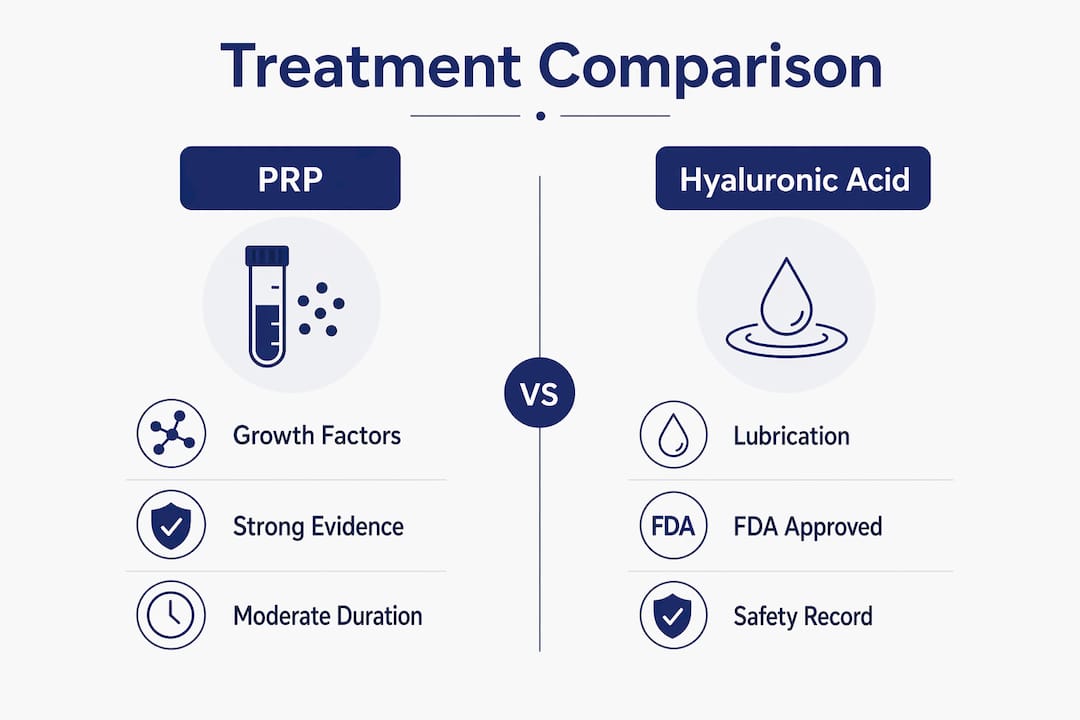
PRP has the strongest current evidence base for knee osteoarthritis. A meta-analysis of 11 RCTs involving 851 participants found significant improvement in overall joint function (measured by WOMAC Total scores), particularly in patients under 60. Pain and stiffness subscales showed more inconsistent results. The most common side effect is a transient injection-site reaction, which typically resolves within a few days. Expert consensus from the ESSKA and ORBIT groups assigns PRP a Level 1B evidence rating for mild to moderate knee osteoarthritis (Kellgren-Lawrence grades 1 through 3), with a standard protocol of three injections per cycle.
Hyaluronic acid is FDA-approved for knee osteoarthritis and has a well-established safety record. A systematic review covering 169 trials and over 21,000 participants found statistically significant but clinically modest improvements in pain and function lasting up to 26 weeks. Some guidelines, including Australian clinical guidelines, advise against routine use in non-knee joints. The gap between statistical significance and real-world clinical relevance is something every patient deserves to understand before committing to a course of HA injections.
Stem cell therapies show genuine promise but carry more uncertainty. Clinical trials have increased substantially, yet heterogeneity in protocols and follow-up periods makes pooled conclusions difficult. Most trials report mostly local, transient adverse events. The signal for symptom relief is encouraging. Definitive proof of durable structural benefit is still pending.
| Treatment | Mechanism | FDA Status | Evidence Level | Typical Duration of Benefit |
|---|---|---|---|---|
| PRP | Growth factors, cytokine modulation | Not FDA-approved as a drug | Level 1B (knee OA, KL 1-3) | 6 to 12 months |
| Hyaluronic acid | Viscosupplementation | FDA-approved (knee OA) | Moderate, mixed guidelines | Up to 26 weeks |
| Stem cell (MSC) | Paracrine signaling, immune modulation | Investigational | Promising, limited certainty | Variable |
| Prolotherapy | Irritant-induced healing response | Not FDA-approved | Limited, early-stage | Variable |
Pro Tip: If you are comparing PRP clinics, ask about their preparation method and platelet concentration. PRP dose variability is one of the primary reasons outcomes differ between patients and between clinics. Not all PRP is the same.
Who is a good candidate for regenerative arthritis treatments?
Patient selection is where regenerative medicine either delivers or disappoints. We see this consistently in practice. The patients who benefit most are those who come in early enough for these therapies to make a meaningful difference.
The clearest evidence supports regenerative treatments for patients with mild to moderate osteoarthritis, corresponding to Kellgren-Lawrence (KL) grades 1 through 3. Expert consensus confirms that benefit diminishes significantly at KL grade 4, where joint space is severely narrowed and structural damage is advanced. At that stage, joint replacement is often the more appropriate conversation.
Beyond disease stage, several patient factors influence outcomes:
- Age: PRP shows stronger functional improvement in patients under 60, based on meta-analysis data
- Activity level: Patients who combine regenerative treatment with physical therapy and movement tend to maintain benefits longer
- Joint involved: Evidence is strongest for the knee; evidence for hip, shoulder, and ankle joints is more limited
- Overall health: Conditions like uncontrolled diabetes or active infection can affect healing response and eligibility
- Realistic expectations: Patients who understand these therapies as symptom-modifying biologics rather than guaranteed cures report higher satisfaction
A multidisciplinary approach matters here. Regenerative injections work best as part of a broader plan that includes physical therapy, weight management where relevant, and activity modification. The injection alone rarely produces lasting results without supporting lifestyle factors.
If you are wondering whether PRP for knees specifically fits your situation, the answer depends heavily on your KL grade and how long you have been managing symptoms.
What does the latest research say about effectiveness and limitations?
The research picture in 2026 is more nuanced than either enthusiasts or skeptics typically present. Here is what the evidence actually shows.
PRP has the most consistent support. The meta-analysis of 851 knee OA patients found meaningful functional gains, especially in younger patients. Those gains are real and clinically relevant for the right population. What the same data also shows is that pain reduction results are inconsistent across studies. Function improves more reliably than pain scores, which is a useful distinction when setting expectations with patients.
“Regenerative treatments represent a spectrum of biologic therapies with varying evidence levels, not a guaranteed cartilage regrowth solution.” — StatPearls, NCBI Bookshelf
HA injections present a different challenge. The evidence base is large and the safety profile is good, but the clinical relevance of the benefit is genuinely debated. A Cochrane review of 76 trials confirmed safety and modest benefit. The honest clinical picture is that some patients respond well and others notice very little. Individual response varies more with HA than with PRP.
Stem cell therapies are where the most scientific excitement and the most caution coexist. Experimental programs like ARPA-H’s NITRO initiative are working toward true cartilage and bone repair by activating endogenous progenitor cells. Animal models show near-normal tissue restoration. Human trials are still in early stages. For patients considering stem cell therapy today, the realistic expectation is symptom improvement and inflammation reduction, not structural regeneration.
| Therapy | Key Research Finding | Limitation |
|---|---|---|
| PRP | Significant WOMAC function improvement in 11 RCTs | Inconsistent pain subscale results; dose variability |
| HA | Modest benefit in 169 trials, 21,000+ participants | Clinical relevance debated; mixed guideline support |
| Stem cells (MSC) | Symptom relief signals in multiple trials | Protocol heterogeneity limits pooled conclusions |
The safety profile across all three therapies is generally favorable. Serious adverse events are rare. The more common concern is not harm but unmet expectations, which is why honest pre-treatment education is as important as the treatment itself.
Key takeaways
Regenerative treatments for arthritis work best in mild to moderate disease stages, using biologic therapies like PRP, HA, and MSC to reduce inflammation and improve function rather than reverse structural damage.
| Point | Details |
|---|---|
| Best for early to moderate arthritis | KL grades 1 to 3 show the strongest response; advanced disease benefits less. |
| PRP has the strongest evidence | Meta-analysis of 851 patients shows significant functional improvement, especially under age 60. |
| Stem cells work via signaling, not replacement | MSCs modulate inflammation and joint environment through paracrine mechanisms, not direct cartilage repair. |
| HA is FDA-approved but modestly effective | Benefits are real but clinically modest; individual response varies significantly. |
| Patient selection determines outcomes | Age, disease stage, joint involved, and lifestyle factors all affect how well regenerative therapy works. |
What I’ve learned from watching patients choose regenerative care
Many patients arrive at Nortex Tissue Regeneration after years of managing arthritis with NSAIDs, cortisone injections, and activity restrictions. They are not looking for a miracle. They are looking for something that actually addresses the source of the problem rather than just quieting it temporarily.
What I find most important to communicate is this: regenerative therapies are not a single thing. PRP, HA, and stem cell treatments each work differently, carry different evidence, and suit different patients. Treating them as interchangeable is one of the most common mistakes I see, both in how clinics market these services and in how patients research them.
The patients who do best are the ones who come in with realistic expectations and a willingness to engage with the full treatment picture. That means physical therapy. That means understanding that three PRP injections over a few months is a process, not a quick fix. That means knowing that if you are at KL grade 4, we will tell you honestly that a different conversation may be more appropriate.
What gives me genuine optimism is the trajectory of the science. The mechanisms are becoming clearer. The protocols are becoming more standardized. And for the right patient at the right stage, these therapies offer something that surgery cannot: a path toward better function without the recovery burden, the surgical risks, or the permanence of joint replacement.
The goal is always to help you get back to the life you want to live. That starts with an honest assessment, not a sales pitch.
— Felix
How Nortex Tissue Regeneration can help you take the next step
At Nortex Tissue Regeneration, we work with adults across North Texas who are managing arthritis and want to explore non-surgical options grounded in evidence. Our team offers PRP therapy and stem cell treatment as part of personalized care plans designed around your specific joint, disease stage, and health goals. We do not offer one-size-fits-all protocols. Every patient receives a thorough evaluation before any treatment recommendation is made. If you are curious whether you are a good candidate for regenerative care, the most useful first step is a consultation where we can review your imaging, discuss your history, and give you an honest picture of what these therapies can and cannot do for you.
FAQ
What is the main benefit of regenerative therapy for arthritis?
The primary benefit is reducing pain and improving joint function without surgery by using biologic agents like PRP or stem cells to modulate inflammation and support the joint’s natural repair processes.
How long does PRP treatment take to work for arthritis?
Most patients notice improvement within four to eight weeks after a full PRP cycle of three injections, with functional benefits typically lasting six to twelve months based on current clinical evidence.
Is stem cell therapy for arthritis proven to work?
Stem cell therapies show consistent signals for symptom relief in clinical trials, but protocol heterogeneity across studies means definitive proof of durable structural benefit is still being established.
Who should not pursue regenerative arthritis treatments?
Patients with advanced osteoarthritis at Kellgren-Lawrence grade 4, active joint infection, uncontrolled systemic disease, or those who are candidates for joint replacement typically see limited benefit from regenerative injections.
Are regenerative treatments for arthritis covered by insurance?
Most regenerative therapies including PRP and stem cell injections are not covered by standard insurance plans in the United States, as they are classified as investigational or elective procedures for arthritis management.