

Musculoskeletal regeneration is defined as the biological and therapeutic process of repairing and regrowing damaged tissues in the musculoskeletal system, including bone, muscle, tendons, ligaments, and cartilage, rather than simply managing pain symptoms. Unlike conventional treatments that focus on reducing discomfort, regenerative approaches aim to restore the structural integrity and function of injured or degenerated tissue. Therapies in this category range from FDA-cleared options like viscosupplementation to investigational biologics such as platelet-rich plasma (PRP) and cell-based treatments. At Nortex Tissue Regeneration, we work with patients every day who want to understand what these options actually mean before committing to a treatment path.
What is musculoskeletal regeneration and how does it work?
Musculoskeletal regeneration refers to a category of treatments that promote tissue repair in bones, cartilage, tendons, ligaments, and skeletal muscle rather than masking symptoms with medication or replacing tissue through surgery. The term “regenerative medicine” covers a wide spectrum of approaches, and not all of them carry the same level of clinical evidence or regulatory approval. Understanding the distinction matters, especially when you are weighing non-surgical options for a chronic joint condition or a slow-healing injury.
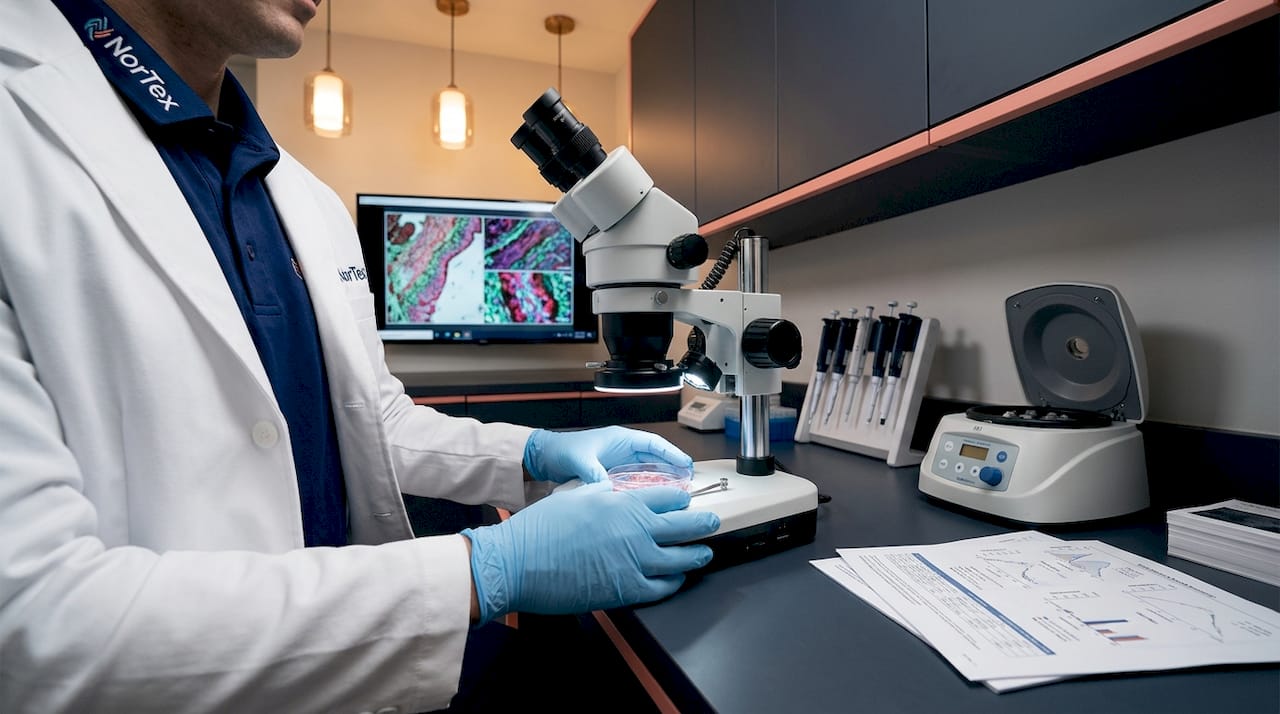
The musculoskeletal healing process relies on the body’s own biological signals. Growth factors, immune cells, and structural proteins coordinate to rebuild damaged tissue over time. Regenerative therapies work by amplifying, supporting, or supplementing that process. PRP, for example, concentrates growth factors from your own blood and delivers them directly to an injury site. Viscosupplementation restores the lubricating fluid in a joint. Cell-based therapies introduce mesenchymal stromal cells that may support tissue repair at a deeper level.
What separates regenerative medicine from standard orthopedic care is the intent. Standard care often focuses on pain relief and functional compensation. Regenerative approaches target the tissue itself, aiming for durable structural improvement. That distinction shapes everything from how a treatment is administered to how long you should expect to wait before seeing meaningful results.
What are the main types of musculoskeletal regenerative therapies?
Four primary therapies define the current regenerative medicine landscape for musculoskeletal conditions: viscosupplementation, prolotherapy, platelet-rich plasma, and mesenchymal stromal cell treatments. Each targets a different mechanism, and each carries a different regulatory status.
-
Viscosupplementation: Hyaluronic acid injections delivered directly into a joint, most commonly the knee. This is the most established option in this category, with FDA clearance specifically for knee osteoarthritis. It works by restoring the viscosity of synovial fluid, reducing friction and improving joint comfort over weeks to months.
-
Prolotherapy: An injection of an irritant solution, typically dextrose, into a damaged tendon or ligament attachment point. The mild inflammatory response it triggers is intended to stimulate the body’s natural repair cascade. Evidence is mixed, and it remains off-label for most indications, but some patients with chronic tendon pain report meaningful improvement.
-
Platelet-rich plasma (PRP): A biologic therapy derived from your own blood. A blood draw is centrifuged to concentrate platelets and their associated growth factors, which are then injected into the target tissue. PRP is investigational or off-label for most musculoskeletal applications, though clinical research, particularly in knee osteoarthritis and tendinopathy, continues to grow.
-
Mesenchymal stromal cell therapies: Cell-based treatments that introduce stem-like cells capable of modulating inflammation and potentially supporting tissue repair. These remain largely experimental, with ongoing trials examining their role in cartilage, bone, and muscle repair.
Pro Tip: Ask any provider to specify the regulatory status of the therapy they are recommending. “Regenerative” does not automatically mean FDA-approved for your specific condition. Knowing whether a treatment is cleared, investigational, or off-label helps you evaluate the evidence honestly.
The mechanism behind each therapy matters as much as the label. A treatment that works well for joint cartilage may not be appropriate for a tendon injury. Regenerative therapies target specific tissues, so matching the approach to the tissue type and injury stage is a core part of good clinical decision-making.
What does the science say about regenerative treatment outcomes?
The evidence base for musculoskeletal regeneration is growing, but it is not uniform across therapies or conditions. Here is a summary of what current research shows for the most studied approaches.
| Therapy | Condition | Key Finding | Evidence Level |
|---|---|---|---|
| PRP | Knee osteoarthritis | Significant improvement in overall function (WOMAC score); stronger benefit in patients under 60 | Meta-analysis, 11 RCTs, 851 participants |
| Aragonite scaffold | Osteochondral lesions | Superior KOOS scores and lower failure rates vs. microfracture at 5 years | RCT, 5-year follow-up |
| Viscosupplementation | Knee OA | FDA-cleared; improves lubrication and short-to-medium term comfort | Multiple RCTs |
| Cell-based therapies | Various | Promising early data; outcomes vary significantly by protocol | Mostly Phase I/II trials |
A meta-analysis of 11 RCTs involving 851 participants found that PRP injections produced significant improvement in overall knee function scores, particularly in patients under 60 receiving multiple doses. This finding is meaningful because it suggests PRP is not a one-size-fits-all solution. Age and dosing protocol both influence how well the therapy performs.
For cartilage repair, a five-year randomized controlled trial found that an aragonite-based scaffold outperformed standard arthroscopic debridement and microfracture in adults with specific lesion sizes and mild to moderate osteoarthritis. That is a clinically significant result because most cartilage repair studies only report outcomes at one or two years, which can overstate durability.
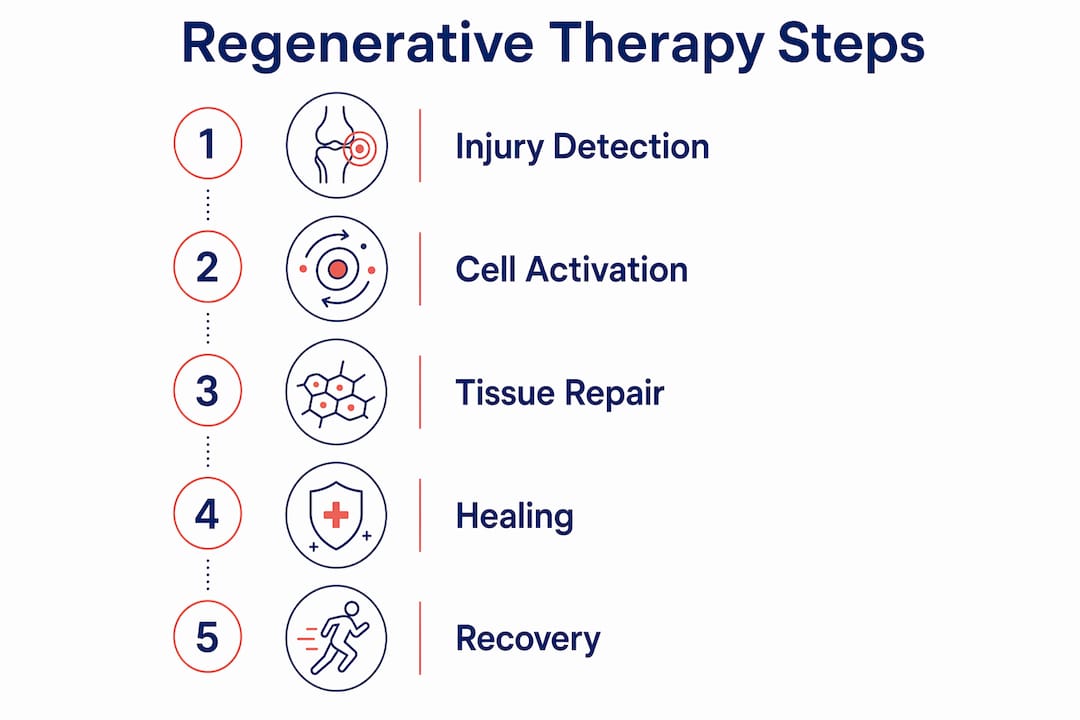
Skeletal muscle regeneration follows a defined biological sequence over one to three weeks, involving inflammation, satellite cell activation, differentiation, and remodeling. This process has real limits. In cases of volumetric muscle loss, the body’s intrinsic repair capacity is overwhelmed, and standard regenerative approaches are often insufficient without engineered tissue support. Safety profiles across these therapies are generally favorable, with transient injection-site reactions being the most commonly reported adverse event.
How does tissue regeneration in muscles and bones actually work?
The biology of musculoskeletal healing differs significantly depending on which tissue is involved. Bone has a relatively strong regenerative capacity. Cartilage has very little. Tendons and ligaments fall somewhere in between, and skeletal muscle operates on its own distinct repair timeline.
Skeletal muscle regeneration follows four coordinated phases:
- Inflammation: Immediately after injury, immune cells flood the area to clear debris and signal repair. This phase is necessary, not harmful, though it produces the soreness and swelling most people associate with injury.
- Satellite cell activation: Muscle stem cells, called satellite cells, are activated by the inflammatory signals. These cells are the primary drivers of muscle fiber repair and are essential to regeneration.
- Differentiation and fusion: Activated satellite cells multiply and fuse to form new myotubes, the precursors to mature muscle fibers. This process takes roughly one to three weeks depending on injury severity.
- Remodeling: New fibers mature and integrate into the existing muscle architecture, gradually restoring contractile function.
Bone repair follows a similar multi-phase process, with osteoblasts and osteoclasts coordinating to rebuild mineralized tissue. Cartilage, by contrast, lacks a direct blood supply, which severely limits its ability to self-repair. This is why cartilage injuries are among the most difficult to treat and why scaffold-based and biologic approaches have attracted so much research attention.
The extracellular matrix, the structural scaffolding that surrounds cells in every tissue, plays a critical supporting role throughout all of these processes. When the matrix is disrupted by severe injury or degeneration, even a well-timed biologic injection may not produce the expected result. Aging compounds this challenge by reducing satellite cell responsiveness and slowing immune coordination.
Pro Tip: If you are over 50 and exploring regenerative options, ask your provider specifically how age-related changes in tissue biology might affect your expected outcomes. The research on PRP, for example, shows stronger results in patients under 60, and that is worth factoring into your decision.
What should patients know before choosing a regenerative treatment?
Many patients come to us after months of physical therapy, anti-inflammatory medications, or cortisone injections that provided only temporary relief. Regenerative options often feel like a logical next step, and in many cases they are. But there are practical realities worth understanding before you commit.
-
Tissue type determines treatment choice. What works for knee cartilage may not be appropriate for a rotator cuff tendon or a partially torn ligament. Protocol and patient selection are among the strongest predictors of outcome, which is why a thorough evaluation matters more than picking a therapy by name.
-
Regulatory status is not uniform. Viscosupplementation is FDA-cleared for knee osteoarthritis. PRP and most cell-based therapies are investigational or off-label for musculoskeletal indications. Off-label does not mean unsafe or ineffective, but it does mean the evidence base is still developing, and you should understand that distinction.
-
Provider and protocol variability is real. PRP preparation methods differ significantly between clinics. The concentration of platelets, the presence or absence of white blood cells, and the volume injected all influence biological activity. Outcomes vary substantially between providers using the same therapy label but different preparation protocols. Asking about preparation standards is a reasonable and informed question.
-
Non-surgical does not mean instant. Regenerative therapies work with biological timelines. Most patients need several weeks to months before meaningful improvement becomes apparent. Studies that track outcomes over five years, like the aragonite scaffold trial, give a more honest picture of durability than those reporting only at six months.
-
Surgery remains appropriate in some cases. Regenerative medicine is not a replacement for surgery when surgery is clearly indicated. A complete ACL rupture, a severely displaced fracture, or advanced joint destruction may require surgical intervention first. The goal is to use regenerative approaches where the evidence supports them, not to avoid surgery at all costs.
Key takeaways
Musculoskeletal regeneration works best when the therapy matches the tissue type, injury stage, and patient biology rather than being applied as a universal solution.
| Point | Details |
|---|---|
| Regeneration vs. symptom relief | Regenerative therapies target structural tissue repair, not just pain reduction. |
| PRP evidence in knee OA | Meta-analysis of 851 patients shows functional improvement, especially in patients under 60 with multiple doses. |
| Cartilage has limited self-repair | Scaffold-based and biologic approaches are needed because cartilage lacks a direct blood supply. |
| Protocol quality affects outcomes | PRP preparation standards vary significantly between providers and directly influence clinical results. |
| Regulatory status varies | Viscosupplementation is FDA-cleared; PRP and cell therapies remain investigational for most indications. |
What I have learned from watching patients navigate regenerative care
I have seen a pattern repeat itself more times than I can count. A patient arrives having already spent a year managing a knee or shoulder condition with cortisone injections and rest. They have heard about PRP or stem cell therapy from a friend or an article online, and they arrive either fully convinced it will fix everything or deeply skeptical that it is anything more than marketing. Both reactions make sense given how regenerative medicine is often discussed.
What I have found is that the patients who do best are the ones who come in with realistic expectations and a willingness to engage with the evidence. PRP does not rebuild a joint overnight. A scaffold does not replace the need for rehabilitation. What these therapies can do, when applied correctly and to the right patient, is give the body a meaningful biological advantage in a repair process it was already trying to complete.
The science is genuinely promising, and it is also genuinely incomplete. We do not yet have long-term data for every therapy in every tissue type. What we do have is a growing body of well-designed trials showing that certain approaches, in certain patients, produce durable improvements that standard care does not. That is worth taking seriously. It is also worth approaching with the same critical thinking you would apply to any medical decision.
My advice is straightforward. Ask your provider what the evidence shows for your specific condition, not for regenerative medicine in general. Ask how long the follow-up was in the studies they are citing. And ask what the realistic timeline looks like for your recovery. Those three questions will tell you a great deal about whether you are in the right hands.
— Felix
Explore regenerative treatment options at Nortex Tissue Regeneration
If you are dealing with chronic joint pain, a slow-healing tendon injury, or early-stage arthritis and want to understand whether a non-surgical approach is right for you, Nortex Tissue Regeneration offers a thorough evaluation to help you find out. Our PRP therapy program is built on evidence-based preparation protocols and personalized dosing, not a one-size-fits-all injection. We also offer stem cell treatments for patients who may benefit from cell-based approaches. The first step is a conversation about your condition, your history, and what the research actually supports for your situation.
FAQ
What is musculoskeletal regeneration in simple terms?
Musculoskeletal regeneration is the process of repairing and regrowing damaged tissues in the bones, muscles, tendons, ligaments, and cartilage using biological or minimally invasive therapies. The goal is structural tissue repair, not just symptom relief.
How long does musculoskeletal injury recovery take with regenerative therapy?
Recovery timelines vary by tissue type and therapy. Skeletal muscle regeneration takes roughly one to three weeks for initial myotube formation, but full functional restoration can take months. Cartilage repair studies with meaningful follow-up track outcomes over five years.
Is PRP therapy approved by the FDA for musculoskeletal conditions?
PRP is not FDA-approved for most musculoskeletal indications and is considered investigational or off-label in those contexts. Viscosupplementation is the most established FDA-cleared regenerative option for knee osteoarthritis specifically.
Does age affect how well regenerative treatments work?
Yes. Research on PRP in knee osteoarthritis shows stronger functional improvements in patients under 60, which reflects broader biological patterns in tissue repair capacity. Satellite cell responsiveness and immune coordination both decline with age, affecting outcomes across regenerative therapies.
How is regenerative medicine different from surgery for joint repair?
Regenerative medicine uses biological agents to support the body’s own repair processes, while surgery physically reconstructs or removes damaged tissue. Non-surgical regenerative options are appropriate for many early-to-moderate conditions, but surgery remains the standard of care when structural damage is severe or complete.