

Chronic joint pain and sports injuries don’t just slow you down physically. They erode your confidence, limit your training, and create real pressure to find a solution fast. In North Texas, more active adults and athletes are turning to regenerative medicine for answers, and the options are multiplying quickly. PRP, stem cell therapy, prolotherapy, and other biologic treatments all promise meaningful pain relief without surgery. But not every claim holds up under scrutiny, and choosing the wrong path can cost you time, money, and the gains you’ve worked hard to protect. This guide gives you a practical, evidence-backed framework for making that choice wisely.
Table of Contents
- Understand the basics: Regenerative treatment options explained
- Step 1: Start with evidence-based diagnosis and conservative care
- Step 2: Match treatment type to condition and stage
- Assess safety, legitimacy, and protocol transparency
- A hard-won lesson: Choosing treatments isn’t just about new technology
- Explore evidence-based regenerative therapy options in North Texas
- Frequently asked questions
Key Takeaways
| Point | Details |
|---|---|
| Evaluate diagnosis first | Always confirm the exact pain source and stage before considering regenerative therapies. |
| Start with conservative care | Non-surgical interventions and rehab should precede any biologic or stem cell treatment. |
| Match therapy to stage | PRP is most effective in mild-to-moderate disease, while stem cell therapy is rarely advised for advanced OA. |
| Demand transparency and safety | Choose providers who disclose preparation methods, regulatory status, and realistic outcomes. |
| Beware of miracle claims | Avoid clinics offering unproven cures and seek evidence-based, regulated treatments. |
Understand the basics: Regenerative treatment options explained
Having set the stage, let’s clarify what regenerative treatments actually are and the main options available to you. Regenerative medicine works on a simple premise: rather than masking pain with medication or removing tissue through surgery, these therapies use your body’s own biology to drive healing and repair. The results can be meaningful, but only when the right treatment matches the right condition.
Regenerative medicine types span a broad spectrum, and each approach works through a distinct mechanism. Regenerative approaches commonly include viscosupplementation (FDA-approved for knee osteoarthritis), prolotherapy, PRP, and mesenchymal stromal or cell-based therapies. Each of those therapies targets tissue repair differently, and none of them is universally appropriate for every patient or every condition.
Here is a quick breakdown of the most widely used options:
| Treatment | Mechanism | Best suited for |
|---|---|---|
| PRP (Platelet-Rich Plasma) | Concentrates growth factors from your own blood to reduce inflammation and stimulate repair | Tendon injuries, mild to moderate joint OA, ligament damage |
| Stem cell therapy | Uses mesenchymal stromal cells to promote tissue regeneration and modulate immune response | Select soft tissue injuries; evidence still emerging for OA |
| Prolotherapy | Irritant solution injected to stimulate localized healing response | Ligament laxity, chronic tendon pain |
| Viscosupplementation | Hyaluronic acid injected into joints to restore lubrication | Knee osteoarthritis, particularly mild to moderate grades |
Understanding these differences matters before you sit down with any provider. When you compare PRP vs stem cell therapy, the decision usually comes down to diagnosis, disease stage, and what the current evidence actually supports for your specific situation. No single therapy is appropriate for every person, and a provider who tells you otherwise should raise a concern.
Key takeaways from this section:
- PRP is well-studied for tendon pathology and select joint conditions; it is not appropriate for advanced arthritis
- Stem cell therapies show promise but remain under active investigation for musculoskeletal conditions
- Prolotherapy and viscosupplementation are useful in specific, well-defined cases
- Choosing among these requires a proper diagnosis first, not a menu-based selection
Step 1: Start with evidence-based diagnosis and conservative care
With a grasp of the main options, it’s essential to start the process with an accurate diagnosis and a proper baseline of conservative care. This step is not optional. It is the foundation that determines whether any regenerative therapy you pursue will actually work or simply delay a better outcome.
An evidence-based diagnosis means identifying your specific pain generator and understanding how far the condition has progressed. For knee osteoarthritis, that typically involves imaging to determine your Kellgren-Lawrence (KL) grade, a standardized scale that measures cartilage loss and joint space narrowing from Grade I (minor) to Grade IV (severe bone-on-bone). This staging matters enormously because the evidence for treatments like PRP differs significantly by grade.
Before any regenerative therapy is appropriate, conservative care and completion of evidence-based baseline treatment are required, with biologic and minimally invasive options considered selectively based on indication and staging. What does that mean in practical terms? It means working through the following sequence:
- Get an accurate diagnosis. Imaging, clinical examination, and functional assessment should confirm what structure is injured, how severely, and whether it is the true source of your pain.
- Complete a supervised rehabilitation program. Physical therapy, exercise-based loading, and movement correction address the muscular and biomechanical factors that often perpetuate injury. Many people improve significantly at this stage alone.
- Address modifiable risk factors. Body weight, activity load, sleep quality, and nutrition all influence tissue healing. Optimizing these before treatment improves your chances of a good result.
- Document your response. Tracking outcomes from conservative care tells your provider whether a regenerative intervention is truly needed, and it establishes a baseline to measure progress against.
- Consult a specialist who performs a formal indication review. This means a clinician who evaluates whether your specific diagnosis and stage actually meet the criteria for the regenerative treatment being considered.
Skipping this sequence creates real problems. Patients who pursue regenerative injections before completing rehabilitation often experience partial or short-lived relief because the underlying biomechanical drivers of their pain remain unaddressed. Worse, they may conclude the treatment failed when the treatment was never the issue.
Pro Tip: Before your consultation, ask your provider to explain which imaging or grading system they use to classify your condition. If they cannot give you a clear answer, that tells you something important about their process.
PRP therapy for knee pain is one of the more studied applications in this space. But even there, results are strongly tied to patient selection and proper staging, not simply the therapy itself.
Step 2: Match treatment type to condition and stage
Once conservative care is complete, selecting the appropriate regenerative therapy depends heavily on your condition’s specifics. This is where the data becomes particularly important, because enthusiasm for new therapies sometimes runs ahead of the evidence.

Appropriateness criteria for PRP for joint pain are well-established in the literature. PRP is rated appropriate mainly for patients within certain OA grades, not as a first-line treatment and not for advanced (KL Grade IV) disease. That distinction matters. If your arthritis has progressed to bone-on-bone changes, PRP is unlikely to provide meaningful structural benefit, and relying on it may delay a more appropriate conversation about other options.
Stem cell therapy occupies a more nuanced position. The interest in cell-based therapies is legitimate, and the science behind mesenchymal stromal cells is genuinely compelling. However, biologic therapies cannot currently be recommended for routine treatment of advanced hip or knee OA, citing limited evidence for significant improvements over existing non-biologic therapies and high out-of-pocket costs. This is a position held by major orthopedic associations, not a fringe view.
Here is how the evidence currently maps treatment to condition and stage:
| Condition and stage | Supported option | Notes |
|---|---|---|
| Mild to moderate knee OA (KL I to III) | PRP | Good evidence; protocol matters significantly |
| Advanced knee OA (KL IV) | Consult orthopedic surgeon | Biologics not well-supported at this stage |
| Tendon injuries (patellar, Achilles, rotator cuff) | PRP | Strong evidence for platelet-rich growth factors |
| Ligament laxity or instability | Prolotherapy | Appropriate when conservative care has not resolved the issue |
| Soft tissue healing post-injury | PRP or cell-based therapy | Depends on tissue type and severity |
“Biologic therapies cannot currently be recommended for routine treatment of advanced hip or knee OA due to limited evidence for significant improvement over existing non-biologic therapies.” — AAHKS Position Statement, 2025
For athletes and active adults specifically, the timing and nature of the injury shift the calculus. An acute muscle or tendon tear in a competitive athlete may benefit from PRP earlier in the treatment cascade than a chronic, low-grade degenerative condition in a weekend recreational athlete. When you compare PRP and prolotherapy for joint healing specifically, the two therapies often complement each other depending on whether the primary problem is inflammatory degeneration or structural laxity.
The key point here is that treatment selection should follow evidence and staging, not marketing claims or peer recommendations alone.
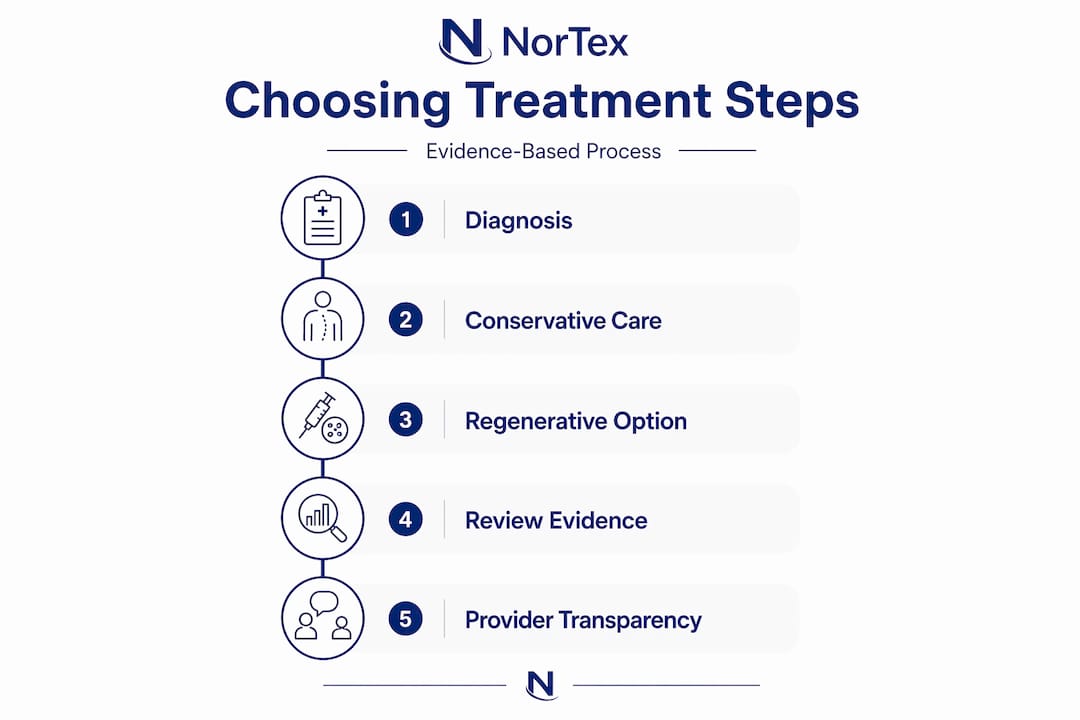
Assess safety, legitimacy, and protocol transparency
Now, before choosing a provider or treatment, it’s critical to assess safety, legitimacy, and transparency to avoid serious pitfalls. This step is one many patients overlook, often because they are focused on the therapy itself and not the environment in which it is being delivered.
Unapproved stem cell products may expose patients to significant safety risks and can delay access to evidence-based treatments. That is a real concern. Adverse events have been documented from products marketed outside of approved clinical pathways, and patients who pursue these treatments often spend considerable money while forgoing established care.
A second issue is variability in PRP preparation methods, dosing, and protocols, which has created genuine uncertainty about which PRP products are most effective and under what conditions. Not all PRP is created equal. The platelet concentration, white blood cell content, activation method, and injection volume all influence outcomes. A clinic that cannot explain its preparation protocol clearly is a red flag.
When evaluating any regenerative provider, ask these questions:
- What regulatory pathway governs the product you are using? FDA-approved products have a defined safety profile; unapproved clinic-marketed products do not.
- What is your PRP preparation protocol? Platelet concentration, spin speed, and additives should be documented and consistent.
- What imaging guidance do you use for injection? Ultrasound or fluoroscopic guidance dramatically improves accuracy and outcomes.
- What rehabilitation protocol follows the injection? Recovery and loading guidelines are part of the treatment, not an afterthought.
- What are the realistic expected outcomes for my specific condition? An honest provider gives you a probability range, not a guarantee.
Pro Tip: Ask the clinic for any published protocol or outcome data they follow. Reputable providers in regenerative medicine reference peer-reviewed literature and established guidelines, not just their own testimonials.
Understanding stem cell injection risks and the factors that explain why some PRP treatments work better than others are both essential parts of making an informed choice.
“Wide variability in PRP preparation methods, dosing, and protocols has created uncertainty in clinical practice.” — AAPM&R Guidance Statement, 2026
This variability is exactly why protocol transparency is non-negotiable when you are selecting a provider. The same therapy delivered by two different clinics with different preparation methods can produce very different results.
A hard-won lesson: Choosing treatments isn’t just about new technology
With the main steps covered, it’s worth sharing a real-world perspective on how to make these decisions wisely rather than reactively.
The regenerative medicine space moves fast. New therapies appear regularly, backed by compelling preliminary data and enthusiastic clinical anecdotes. And some of them genuinely do represent meaningful advances. But the history of medicine is also full of treatments that seemed transformative early on and proved disappointing or even harmful when studied rigorously at scale.
The temptation to skip conservative care and move directly to the newest biologic therapy is understandable. If you’re a competitive athlete with a knee injury, or an active adult whose pain is limiting your daily life, waiting feels like losing. But the evidence consistently shows that patients who complete appropriate conservative care before pursuing regenerative treatment get better long-term outcomes than those who pursue biologics first.
Therapies marketed as “miracle” cures without credible supporting evidence should be approached with real caution. This is not about being skeptical of innovation. It’s about recognizing that a therapy’s novelty is not the same as its effectiveness. The process matters as much as the product.
We’ve seen patients at all stages of this journey. Some arrive after years of managing chronic pain through medications alone and respond beautifully to a well-timed PRP protocol paired with rehabilitation. Others come having already spent significant money on unapproved cell-based therapies with little improvement, and the work then becomes identifying what was missed in their earlier evaluation.
The truth is that long-term results in regenerative medicine depend more on correct patient selection and process than on the sophistication of the technology. When you compare PRP and stem cell options for your own situation, the right answer is almost always the one supported by your diagnosis, staging, and conservative care history, not the one with the most compelling marketing.
Explore evidence-based regenerative therapy options in North Texas
If you’re ready to explore safe, vetted regenerative options, here’s where to start in North Texas.
At Nortex Tissue Regeneration, we specialize in evidence-based, non-surgical approaches to chronic pain and injury recovery. Our team follows established protocols for PRP therapy and stem cell therapy, with transparent preparation standards and image-guided delivery to maximize precision and outcomes. We believe every patient deserves a clear explanation of what we’re doing, why we’re recommending it, and what realistic results look like for their specific condition.
Whether you’re managing early-stage knee arthritis, recovering from a tendon injury, or exploring regenerative healing options after conservative care hasn’t resolved your pain, we’re here to guide you through the decision with honesty and clinical rigor. Serving the North Texas community, our goal is to help you return to the active life you value, with confidence in every step of the process.
Frequently asked questions
Is PRP therapy safe for mild knee osteoarthritis?
PRP is considered safe and appropriate for mild-to-moderate knee OA after conservative care has been completed, though outcomes vary by protocol and by how well the patient has been selected for the therapy.
Are stem cell therapies FDA approved for joint pain?
Most stem cell therapies marketed directly by clinics are not FDA approved for joint pain, and unapproved products carry documented safety risks along with the potential to delay access to evidence-backed care.
How do I know which regenerative treatment fits my injury?
The best fit comes from confirming your specific pain generator and stage, completing conservative care, and then matching the therapy to what the evidence most strongly supports for your diagnosis and progression level.
What risks are associated with regenerative “miracle cures”?
Unapproved therapies can cause adverse events, drain financial resources without insurance coverage, and critically delay access to legitimate, evidence-based treatments that could actually help.