

If you’ve been living with chronic knee pain, hip stiffness, or a nagging sports injury that won’t fully heal, you’ve probably come across clinics promising that stem cell therapy can regenerate your joints and eliminate pain for good. The reality is more nuanced. High-quality reviews show only modest short-term benefit with significant uncertainty around long-term outcomes, yet the marketing often skips that part. This guide is designed to help you cut through the noise, understand what the science actually says, and make an informed decision about whether stem cell therapy is a reasonable next step for your situation.
Table of Contents
- What is stem cell therapy for joint pain?
- What does the evidence really show?
- When is stem cell therapy appropriate to consider?
- Safety, regulation, and common pitfalls
- Our perspective: What most clinics and marketers don’t tell you
- Explore your options for non-surgical joint pain relief
- Frequently asked questions
Key Takeaways
| Point | Details |
|---|---|
| Conservative care first | Exhaust rehab, weight management, and standard pain options before considering experimental therapies. |
| Evidence is limited | Current research finds only small short-term benefit in pain and function for joint pain from stem cell injections. |
| Know the risks | Unapproved stem cell products carry real risks and should be avoided unless part of a regulated clinical trial. |
| Regulation matters | Always verify if a stem cell procedure is FDA-approved or investigational before proceeding. |
| Consult trusted experts | Discuss your options with experienced providers who prioritize evidence-based, legal, and safe therapies. |
What is stem cell therapy for joint pain?
Stem cell therapy for orthopedic conditions involves injecting cells, or cell-derived products, into a damaged joint with the goal of reducing pain and potentially supporting tissue repair. The cells used most commonly in musculoskeletal applications come from bone marrow, adipose (fat) tissue, or donated birth tissues such as amniotic fluid or umbilical cord. Each source produces a different product with a different cellular profile, concentration, and regulatory status.

This is where confusion enters the picture. Not everything marketed as “stem cell therapy” is the same. Some products contain live, viable stem cells. Others contain growth factors, signaling proteins, or cellular debris with little to no active cellular content. A treatment administered at one clinic using one protocol may produce completely different results than a treatment with the same name at another facility because the preparation, the cell count, the delivery method, and the source tissue are all variables.
Common sources of cells used in orthopedic applications include:
- Bone marrow aspirate concentrate (BMAC): Drawn from the patient’s own hip bone and processed to concentrate stem and progenitor cells
- Adipose-derived stem cells: Harvested from the patient’s own fat tissue, typically through a mini-liposuction procedure
- Allogeneic (donated) products: Derived from donor umbilical cord, amniotic membrane, or placental tissue, often marketed as “off-the-shelf” options
- Expanded cell therapies: Cells grown in a laboratory to increase quantity, which require strict FDA oversight and are rarely available outside approved trials
Understanding how stem cells heal joints at a biological level matters because it shapes realistic expectations. Stem cells do not typically “become” new cartilage in the way marketing imagery suggests. Their primary role appears to be signaling, meaning they release chemical messengers that may reduce inflammation, slow cell death, and modestly support natural repair processes.
“Evidence from one protocol or clinic may not generalize to others due to differences in cell sources, preparations, and regulatory status, making direct comparison across studies difficult and outcomes highly variable.”
Pro Tip: When evaluating any clinic’s stem cell offering, ask specifically what product they use, where it comes from, and whether it is autologous (from your own body) or allogeneic (from a donor). Those are not small distinctions. They affect both the safety profile and the clinical evidence supporting the treatment.
What does the evidence really show?
With a basic understanding in place, it’s time to see what clinical evidence tells us about outcomes and expectations for stem cell therapy.
The most reliable data we have focuses on knee osteoarthritis, which is the most studied application. High-quality systematic reviews show only slight short-term improvements in pain and function compared to placebo, with low certainty of evidence. Structural improvements, meaning measurable changes to cartilage, remain largely unproven in humans at this stage.
Here is a summary of where the evidence currently stands:
| Outcome | Evidence Quality | Typical Finding |
|---|---|---|
| Short-term pain relief (up to 6 months) | Low to moderate | Modest improvement in some patients |
| Physical function improvement | Low | Small gains, inconsistent across trials |
| Cartilage structural repair | Very low | No consistent evidence in humans |
| Long-term safety (beyond 1 year) | Insufficient | Not enough data to draw conclusions |
| Serious adverse events | Low risk but not zero | Rare infections, flares, procedural risks |
For sports injuries, such as tendon tears, ligament sprains, and muscle strains, the data is even thinner. Most available studies are small, short in duration, and lack proper placebo controls. Promising early results exist, but they have not yet been replicated in large, well-designed trials.
What does this mean in real terms for you? Most patients who do respond to stem cell therapy for knee osteoarthritis report noticeable but moderate pain reduction for roughly three to six months. Some patients report no change. A smaller subset experiences temporary flare reactions. The likelihood of permanently regrowing lost cartilage based on current evidence is low.
Understanding when stem cell therapy helps joint pain versus when it is unlikely to offer meaningful benefit is a conversation worth having with a qualified clinician before committing to any procedure. And if you are weighing your options, reviewing PRP vs stem cell outcomes side by side can give you a clearer picture of how these two biologic therapies compare in terms of evidence and clinical application.
Key takeaway: Modest, short-term pain relief is plausible for some patients with knee osteoarthritis. Structural repair, long-term cure, and sport-specific injury recovery are not yet well-supported by clinical evidence.
When is stem cell therapy appropriate to consider?
But when does it actually make sense, in real life, to move from standard treatments toward stem cell approaches?
The honest answer is: only after you have genuinely exhausted conservative options and done so with proper guidance. Professional guidelines from sports medicine and orthopedic organizations recommend a stepwise approach that prioritizes proven, lower-risk therapies before moving to investigational options like stem cell injections.
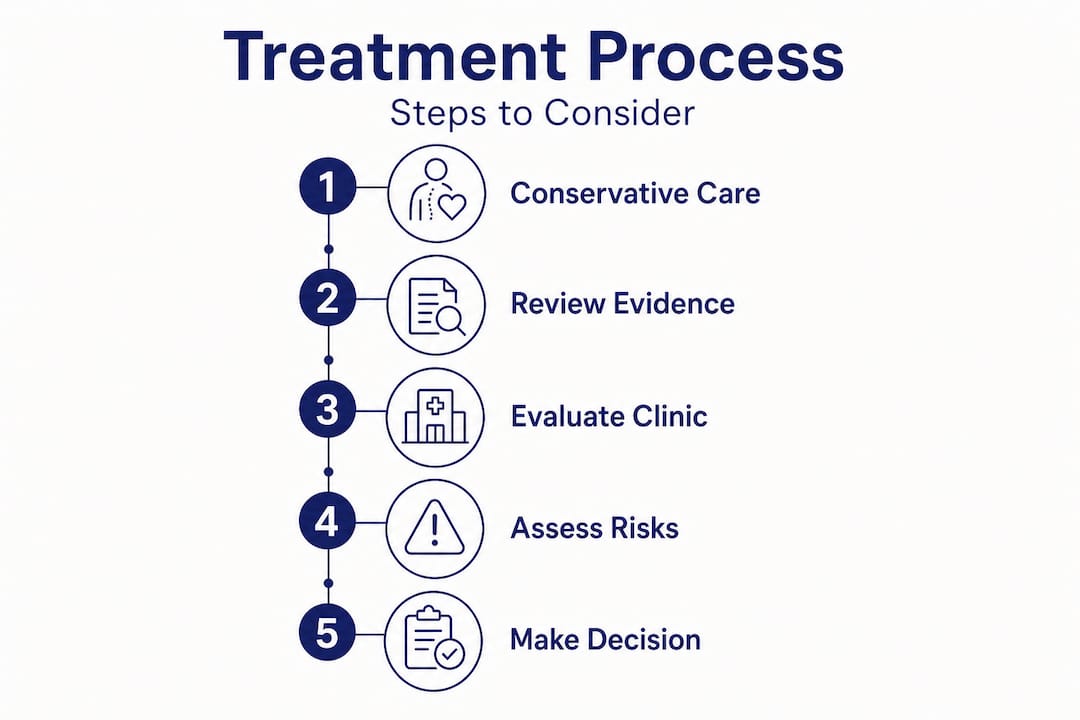
Here is a practical pathway to follow:
- Optimize physical therapy and rehabilitation. A structured program addressing strength, mobility, and movement mechanics is the single best-supported intervention for most joint conditions, including early to moderate osteoarthritis.
- Address weight and metabolic factors. Excess body weight increases joint load significantly. Even modest weight reduction of 10 to 15 pounds can meaningfully reduce knee pain in patients with osteoarthritis.
- Trial anti-inflammatory strategies. This includes NSAIDs, activity modification, and dietary changes that reduce systemic inflammation.
- Consider corticosteroid or hyaluronic acid injections. These are well-established options for short-term relief in knee osteoarthritis and carry a well-understood safety profile.
- Evaluate PRP therapy. Platelet-rich plasma has a stronger evidence base than stem cell therapy for certain conditions and carries fewer regulatory concerns.
- Consider stem cell therapy if earlier steps provide insufficient relief. At this point, a careful discussion with a clinician about the specific product, regulatory status, and realistic outcomes is appropriate.
| Treatment | Best used when | Evidence level |
|---|---|---|
| Physical therapy | Any stage of joint pain, first line | Strong |
| Weight management | Overweight patients with knee OA | Strong |
| Corticosteroid injection | Short-term flare management | Strong |
| Hyaluronic acid injection | Mild to moderate knee OA | Moderate |
| PRP therapy | Mild to moderate OA, tendon injuries | Moderate |
| Stem cell therapy | Conservative options have failed, after informed discussion | Low to moderate |
Reviewing the criteria for stem cell therapy in detail can help you understand whether your clinical picture aligns with the patient profiles showing the most benefit. It is also worth exploring how improving joint mobility through regenerative approaches fits into a broader, comprehensive recovery plan.
Pro Tip: If a provider recommends stem cell therapy as your first or second step without asking about your rehabilitation history, weight, or prior treatment attempts, that is a signal to pause and ask more questions. Evidence-based care always starts with the most proven interventions first.
Safety, regulation, and common pitfalls
Knowing when to consider advanced options is only part of the equation; safety and strict regulatory awareness are crucial for your protection.
The U.S. Food and Drug Administration (FDA) has taken a clear position on many stem cell products marketed for joint pain. Most are not approved for these uses, and the FDA has not reviewed their safety, purity, or quality. The FDA warns patients to avoid unapproved human cell and tissue products, noting that these may pose serious risks including infections, immune reactions, and in rare cases, death.
The terms “investigational” and “off-label” matter here:
- Investigational means the therapy is being studied under a formal clinical trial or research protocol with proper oversight.
- Off-label means a provider is using a product outside its FDA-approved indication, which is legal in some contexts but requires careful disclosure to the patient.
Many clinics in Texas and across the country use these terms loosely or avoid them entirely in marketing materials, which creates real risk for patients who assume they are receiving a fully vetted, approved treatment.
“The FDA has documented cases of patients experiencing serious harm, including infections, tumor formation, and death following the use of unapproved cell-based products for musculoskeletal and other conditions.”
Before agreeing to any stem cell procedure, ask your provider the following questions:
- Is this specific product FDA-approved, FDA-cleared, or neither?
- Is this treatment being offered under an approved clinical trial?
- What is the source of the cells, and how is the product processed and stored?
- What are the documented risks specific to this product and delivery method?
- What happens if I experience a negative reaction, and how will it be managed?
- Can you provide published clinical data supporting this specific protocol?
Understanding the safety comparison between PRP and stem cell therapy is also helpful, as PRP derived from your own blood carries a fundamentally different risk profile than allogeneic (donor-derived) stem cell products.
Our perspective: What most clinics and marketers don’t tell you
We’ve grounded this guide in facts, but what about the big picture that glossy brochures and headlines tend to leave out?
Here is something we believe strongly: the wide variation in what is sold as “stem cell therapy” is one of the biggest sources of harm to patients exploring regenerative options. A clinic using rigorously sourced, properly prepared bone marrow concentrate under experienced clinical supervision is not offering the same thing as a clinic selling off-the-shelf amniotic injections of questionable cellular content. Yet both may use the same language in their marketing. That gap between branding and biology is where patients get hurt, financially and physically.
The evidence landscape is also moving. Research published in the last five years has improved our understanding of who responds to stem cell therapy and under what conditions. But some clinics actively market stem cell therapies as restorative solutions while the evidence base remains limited and FDA caution continues. That is not informed consent. It is sales.
We also want to be honest about something that often gets missed when people compare regenerative options: choosing between PRP and stem cell therapy is not simply a matter of picking the “stronger” treatment. The better question is which option is most appropriate for your specific diagnosis, your prior treatment history, and the realistic outcomes you can expect given current science.
At Nortex Tissue Regeneration, we believe the highest standard of care means giving you accurate expectations before any procedure, not after. The goal is never to sell a treatment. It is to offer the right treatment, at the right time, for the right patient.
Explore your options for non-surgical joint pain relief
If you are in North Texas and dealing with chronic joint pain or a stubborn sports injury, getting a thorough evaluation from a provider who understands both the promise and the limitations of regenerative medicine is the most important step you can take. At Nortex Tissue Regeneration, we offer personalized consultations to help you understand whether stem cell therapy or another biologic treatment is a realistic option for your condition. For patients who may be appropriate candidates, we also offer bone marrow cell therapy using autologous protocols grounded in current evidence. You can learn more about all of our non-surgical treatment options at Nortex Tissue Regeneration and take the first step toward a clearer path forward.
Frequently asked questions
Is stem cell therapy FDA-approved for joint pain?
Most stem cell therapies for joint pain are considered investigational or off-label and are not FDA-approved for these uses, which means patients should ask providers specifically about regulatory status before proceeding.
Are there risks to unapproved stem cell treatments?
Yes. The FDA warns of serious risks from unapproved cell-based therapies, including infections, immune reactions, and deaths, making it essential to verify product approval status before treatment.
How long do pain relief benefits from stem cell injections typically last?
Studies indicate that stem cell injections may slightly improve pain and function for up to six months in some patients, though long-term effects and durability remain uncertain.
What should I ask a provider before considering stem cell therapy?
Ask whether the specific product is FDA-approved, what published clinical evidence supports its use for your diagnosis, and how the clinic monitors and manages any adverse reactions after the procedure.
Can stem cell therapy cure arthritis or regrow cartilage?
Current evidence does not support cartilage regrowth or cure claims. The best available data shows modest pain relief for some patients, with no consistent evidence of structural cartilage restoration in humans.