

Tissue damage and repair is the biological process by which your body detects injury, controls bleeding, clears debris, and rebuilds structure — and the single most important determinant of recovery is whether each healing phase progresses in the right sequence. When that progression stalls, healing becomes chronic. Understanding the four overlapping phases, the factors that disrupt them, and the treatment options available gives you a real foundation for making informed decisions about your care.
Key facts to hold onto:
- The four healing phases are hemostasis, inflammation, proliferation, and remodeling — each overlapping with the next.
- Remodeling can continue for up to 12 months, and a wound typically regains most of its original tensile strength by three months.
- Wounds that have not closed after approximately three months are classified as chronic and require a different clinical approach.
- Experts at institutions like the Hospital for Special Surgery emphasize that personalized protocols, not one-size-fits-all treatments, drive the best outcomes.
Table of Contents
- What actually happens when tissue heals?
- Why do some injuries stop healing?
- Which factors speed up or slow down healing?
- Standard clinical approaches to tissue repair
- How do regenerative therapies work, and who are they for?
- When should you see a clinician, and what are the red flags?
- Surgery versus nonsurgical care: how clinicians decide
- Key Takeaways
- A clinician’s perspective on what we actually see
- Nortextissueregeneration: personalized regenerative care in North Texas
- Useful sources and further reading
- FAQ
What actually happens when tissue heals?
The wound healing process moves through four phases that overlap rather than follow strict boundaries. Here is what each one involves:
| Phase | Approximate Timing | Key Cells and Signals |
|---|---|---|
| Hemostasis | Minutes to hours | Platelets, fibrin clot, PDGF, TGF-β |
| Inflammation | Hours to ~3 days | Neutrophils, macrophages, cytokines, ROS |
| Proliferation | Days 3–21 | Fibroblasts, endothelial cells, VEGF, collagen III |
| Remodeling | Weeks to 12 months | Myofibroblasts, MMPs, collagen I replacement |
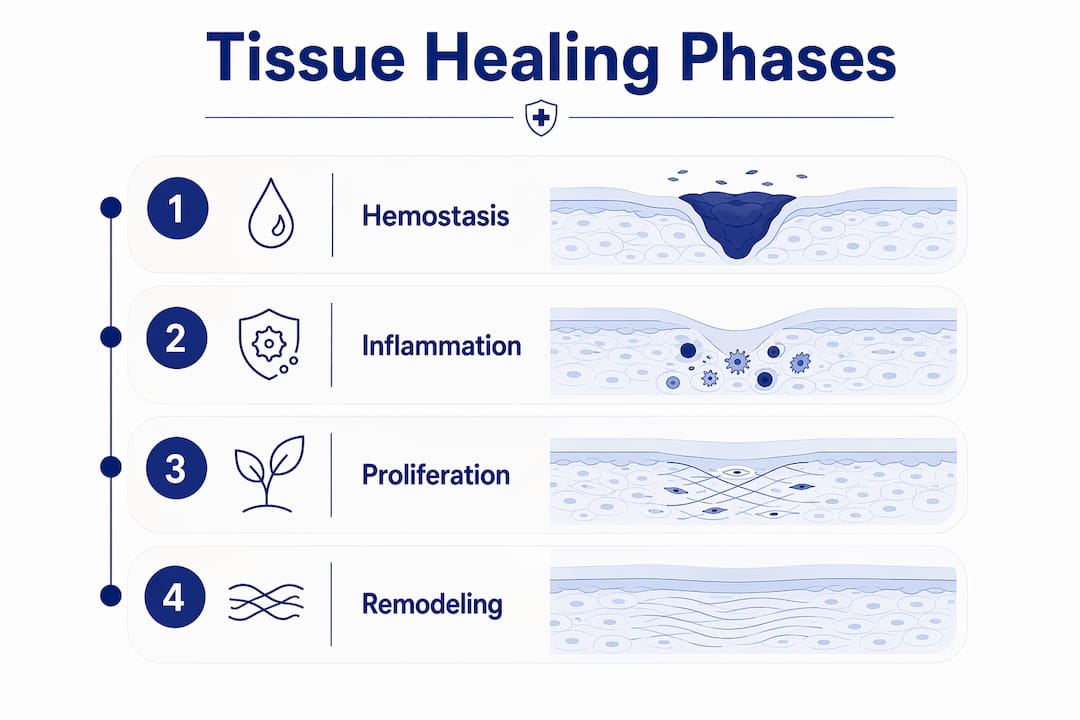
Hemostasis begins within seconds of injury. Blood vessels constrict, platelets aggregate at the wound site, and the coagulation cascade produces a fibrin clot that seals the breach and releases growth factors — including PDGF and TGF-β — that recruit the next wave of cells.
Inflammation follows immediately. Neutrophils arrive first, clearing bacteria and damaged tissue. Macrophages take over within a few days, debride the wound further, and release the cytokines that signal fibroblasts and endothelial cells to move in. Macrophages are genuinely central here: research shows that inhibiting their function delays healing measurably.
Proliferation runs roughly from day 3 to day 21. Fibroblasts lay down collagen type III to fill the wound defect, new blood vessels form through angiogenesis driven by VEGF, and keratinocytes migrate inward to restore the epithelial surface. The result is granulation tissue — vascular, cellular, and temporary.
Remodeling is the longest and most underappreciated phase. Collagen type III is gradually replaced by the stronger collagen type I, fibers are cross-linked and reorganized, and the wound contracts. Patients often feel texture changes or sensitivity for months because this process continues actively for up to a year.
Why do some injuries stop healing?
Most people assume that healing is automatic. It usually is — but several failure modes can lock a wound in a non-healing state, and understanding them explains why chronic wounds need targeted, not just supportive, care.
- Prolonged inflammation: When the inflammatory phase does not resolve, elevated reactive oxygen species (ROS) and NF-κB activation degrade the extracellular matrix and consume growth factors before fibroblasts can use them.
- Biofilm and infection: Bacterial biofilm creates a persistent inflammatory stimulus that prevents the transition to proliferation.
- Ischemia and hypoxia: Collagen synthesis requires oxygen. Poor blood supply starves the wound of the metabolic fuel it needs.
- Senescent fibroblasts: Older or metabolically compromised fibroblasts lose their ability to respond to growth factor signals.
- Protease overactivity: Excess matrix metalloproteinases (MMPs) break down newly deposited collagen and degrade the growth factors that would otherwise drive repair.
Wounds that do not close within approximately three months are classified as chronic and carry a significantly higher risk of complications including infection, loss of function, and in severe cases, amputation. Shifting the wound microenvironment away from prolonged inflammation is the central goal of most targeted therapies.
Chronic wounds are not simply slow wounds. They reflect a fundamentally different biological state, and that distinction matters for how they are treated.
Which factors speed up or slow down healing?
Patient biology often explains why two people with similar injuries have very different recovery paths. Some factors you cannot change; many you can.
Nonmodifiable factors:
- Age (older tissue has slower cellular turnover and reduced growth factor response)
- Genetic predisposition to keloid or hypertrophic scarring
Modifiable factors:
- Diabetes and metabolic health: Elevated blood glucose impairs neutrophil function and collagen synthesis.
- Smoking: Nicotine causes vasoconstriction, directly reducing oxygen delivery to the wound. Smoking cessation is one of the highest-impact changes a patient can make before any procedure.
- Nutrition: Collagen synthesis requires vitamin C and adequate protein; deficiencies reduce both repair quality and tensile strength.
- Vascular supply: Ischemia limits oxygen and nutrient delivery. Conditions like peripheral artery disease significantly impair outcomes.
- Infection control: Uncontrolled infection sustains inflammation and prevents phase progression.
- Medications: Corticosteroids and immunosuppressants blunt the inflammatory signals that initiate repair.
- Mechanical stress: Excess movement or tension over a healing wound promotes poor scar formation; appropriate offloading supports collagen alignment.
Pro Tip: If you are preparing for a procedure or managing a slow-healing wound, address glycemic control, smoking, and nutritional status first. These three changes improve the biological environment before any advanced therapy is introduced, and they are within your control.
For older adults managing recovery at home, practical discharge and recovery planning — including wound monitoring and activity guidance — can make a real difference in outcomes. Resources like senior recovery guidance offer useful frameworks for families navigating this.
Standard clinical approaches to tissue repair
Before biologics or surgery enter the picture, conservative care addresses the fundamentals of the healing environment.
- Wound care basics: Gentle cleansing, moisture-balanced dressings, and timely debridement of nonviable tissue keep the wound bed clean and receptive to repair signals.
- Infection control: Topical or systemic antimicrobials when indicated; biofilm management for chronic wounds.
- Offloading and immobilization: Reducing mechanical stress on healing tissue — through bracing, casting, or activity modification — prevents disruption of new collagen.
- Rehabilitation: Graduated physical therapy and progressive loading, introduced at the right phase, support collagen alignment and functional recovery.
- Adjunct therapies: Negative-pressure wound therapy (wound VAC) accelerates granulation in selected wounds; hyperbaric oxygen therapy improves oxygen delivery in ischemic or radiation-damaged tissue for specific indications.
Most patients we see have already tried several of these approaches before seeking a regenerative evaluation. That history matters — it tells us which biological barriers remain and what the tissue environment actually looks like.
How do regenerative therapies work, and who are they for?
Regenerative therapies aim to supply the biological signals or cells that a stalled wound or degenerating joint is no longer producing adequately. The mechanisms differ by therapy.
- PRP (Platelet-Rich Plasma): A patient’s own blood is processed to concentrate platelets, which are then injected at the injury site. The concentrated platelets release PDGF, TGF-β, VEGF, and other growth factors to stimulate local repair. Common uses include chronic tendinopathies, osteoarthritis symptom management, and certain ligament conditions.
- Stem cell–based approaches: Mesenchymal stromal cells are delivered to supply reparative factors and potentially support tissue regeneration. Many applications remain investigational or off-label.
- Prolotherapy: An irritant solution — typically hypertonic dextrose — is injected to provoke a controlled inflammatory response that stimulates fibroblast activity and collagen deposition.
- Viscosupplementation: Hyaluronic acid injections modify the joint microenvironment to improve lubrication. This is the one modality with FDA-cleared indications for knee osteoarthritis; most PRP and cell-based therapies remain investigational for many uses.
For a broader comparison of these options, the types of regenerative medicine for joint pain overview is a useful starting point.
“While regenerative medicine offers real promise for chronic musculoskeletal conditions, clinical outcomes are highly heterogeneous. Patient selection and individualized protocols are critical determinants of benefit — these are not universal cures, and their success depends on cell quality, the host metabolic environment, and local tissue conditions.” — Hospital for Special Surgery
Pro Tip: The best candidates for regenerative therapies have optimized their modifiable factors first — glycemic control, smoking cessation, adequate nutrition — and have a clear, measurable goal (pain reduction, improved function, wound closure). Patients who arrive with uncontrolled diabetes or active infection are unlikely to respond well regardless of the therapy chosen.
When should you see a clinician, and what are the red flags?
Most soft tissue injuries can be monitored conservatively for a period, but certain signs require prompt evaluation.
Red flags that need urgent attention:
- Spreading redness, warmth, or streaking around a wound (signs of spreading infection)
- Fever or systemic signs of illness alongside a wound
- Rapid or progressive loss of function in a limb
- Numbness, tingling, or absent pulse distal to an injury (neurovascular compromise)
- Uncontrolled bleeding
Decision framework for choosing care:
- Mild injuries with intact function: conservative care, monitoring, and reassessment at 4–6 weeks.
- Injuries with partial function loss or slow progress: physical therapy evaluation, possible imaging, and discussion of adjunct options.
- Wounds or injuries not progressing after three months: multidisciplinary evaluation including wound care specialists or regenerative medicine consultation.
Questions worth asking any provider: What is the evidence for this treatment in my specific condition? What are the realistic alternatives? What timeline should I expect, and how will we measure progress? What are the risks and the follow-up plan?
Surgery versus nonsurgical care: how clinicians decide
Surgery is appropriate in specific circumstances, not as a default when conservative care has not worked quickly enough.
Common surgical indications:
- Structural instability (complete ligament tears, fractures with displacement)
- Full-thickness tendon or muscle tears with significant functional loss
- Refractory infection or nonviable tissue requiring debridement or reconstruction
- Tumors or lesions requiring excision
When nonsurgical or regenerative care is reasonable:
- Partial tears with preserved function and no instability
- Osteoarthritis without mechanical locking or severe structural compromise
- Chronic wounds in patients who are poor surgical candidates due to comorbidities
Surgery and biologics are not mutually exclusive. PRP is sometimes used intraoperatively or post-surgically to support tissue repair, and regenerative therapy can speed recovery in the rehabilitation phase following a procedure.
Questions to ask a surgeon: Is this repair urgent, or is there a reasonable window to try conservative options? What is the expected recovery timeline and return to function? What happens if I delay surgery by 3–6 months?
Key Takeaways
Tissue heals through four overlapping phases, and recovery quality depends on whether each phase progresses without disruption — a process that can take up to 12 months for full remodeling.
| Point | Details |
|---|---|
| Four phases drive all healing | Hemostasis, inflammation, proliferation, and remodeling must progress in sequence for normal repair. |
| Remodeling takes up to 12 months | Tensile strength reaches approximately 80% of original by three months; full remodeling continues beyond that. |
| Chronic wounds need different care | Wounds not closed after approximately three months are classified as chronic and require targeted intervention. |
| Modifiable factors matter most | Smoking cessation, glycemic control, and nutrition are the highest-impact changes patients can make before any treatment. |
| Nortextissueregeneration offers individualized evaluation | The clinic provides personalized regenerative plans — PRP, stem cell therapy, prolotherapy — based on each patient’s biology and goals. |
A clinician’s perspective on what we actually see
Many patients arrive after months of conservative care that helped somewhat but did not resolve the problem. That pattern is common, and it is not a failure — it usually means the biological environment needs more attention than standard care can provide alone.
What we often find is that the patients who respond best to regenerative therapies are those who have already addressed their modifiable factors. The ones who are still smoking, managing poorly controlled blood sugar, or significantly deconditioned tend to have more variable results, regardless of which therapy we use. That is not a reason to avoid treatment — it is a reason to optimize first.
Timelines matter too. We are honest with patients that measurable improvement in pain and function typically takes weeks to months, not days. Wound closure in a chronic wound may take multiple treatment cycles. Setting those expectations clearly, and agreeing on measurable goals before starting, is part of how we build a plan that is actually useful rather than just hopeful.
Nortextissueregeneration: personalized regenerative care in North Texas
If you are managing a slow-healing injury, chronic joint pain, or a condition that has not responded fully to conservative care, Nortextissueregeneration offers a structured evaluation to determine whether regenerative therapies are appropriate for your situation.
Services include stem cell therapy, PRP therapy, prolotherapy, and individualized treatment planning — all without surgery or prolonged downtime. No guarantees are made about outcomes; what we offer is a thorough assessment, a clear explanation of the evidence, and a protocol built around your biology and goals.
To request a consultation, contact the clinic directly through the website. Bring any imaging, prior treatment records, and a list of current medications to your first appointment.
Useful sources and further reading
- Wound Healing Phases — StatPearls, NCBI Bookshelf
- Physiology, Wound Healing — StatPearls, NCBI Bookshelf
- Wound Physiology (Archived) — StatPearls, NCBI Bookshelf
- Cellular and Molecular Mechanisms of Wound Repair — PMC
- Regenerative Medicine Treatments — Hospital for Special Surgery Health Library
- Regenerative Therapy in Pain — StatPearls, NCBI Bookshelf
- Prolotherapy and Viscosupplementation — PubMed
This article is general health information, not medical advice. Consult a qualified clinician for guidance specific to your condition and circumstances.
FAQ
What are the four phases of tissue healing?
The four phases are hemostasis, inflammation, proliferation, and remodeling. They overlap in timing and together can span from hours after injury to up to 12 months for full remodeling.
When is a wound considered chronic?
A wound that has not closed after approximately three months is classified as chronic and typically requires multidisciplinary or targeted intervention beyond standard wound care.
How does PRP support tissue repair?
PRP concentrates platelets from a patient’s own blood and delivers growth factors — including PDGF, TGF-β, and VEGF — directly to the injury site to stimulate local repair. Outcomes vary based on patient selection and protocol.
What factors most affect how quickly tissue heals?
Smoking, uncontrolled blood glucose, poor nutrition (especially vitamin C and protein deficiency), ischemia, and active infection are among the most impactful modifiable factors that slow healing.
Does Nortextissueregeneration offer regenerative evaluations?
Yes. Nortextissueregeneration provides individualized consultations and treatment planning for patients exploring PRP, stem cell therapy, and prolotherapy for chronic pain, injury recovery, and tissue healing.