
You’ve just completed your stem cell therapy procedure, and now comes the part that most patients underestimate: aftercare. Many people focus heavily on choosing the right clinic and the right treatment, then feel uncertain about what to do once they walk out the door. The truth is, structured post-injection rehab can have a real impact on how well your body responds and how quickly you recover. This guide gives you clear, step-by-step aftercare strategies tailored for North Texas patients who want to protect their results and support long-term healing.
Table of Contents
- What you need before starting aftercare
- Step-by-step: Core aftercare actions for your first six weeks
- What to expect: Monitoring, troubleshooting, and adjusting your plan
- Why aftercare isn’t ‘one-size-fits-all’: The clinic and research perspective
- The real truth: What patients should demand (but rarely get) in aftercare advice
- Get expert-guided recovery support in North Texas
- Frequently asked questions
Key Takeaways
| Point | Details |
|---|---|
| Gather essentials | Start with clear instructions and the right supplies to set yourself up for effective aftercare. |
| Follow phased steps | Progress activity gradually, using evidence-based actions in line with your provider’s plan. |
| Monitor closely | Watch for both normal healing responses and warning signs, adjusting your plan as needed. |
| Personalized protocols | Recognize that protocols may differ and advocating for clear communication leads to better outcomes. |
What you need before starting aftercare
Once you understand the importance of aftercare, it helps to gather what you’ll need before you start. Preparation isn’t just about collecting supplies. It’s about making sure you and your care team are aligned from the beginning.
Your first step is securing your written aftercare plan from your clinic. If you didn’t receive one, ask for it before you leave. Knowing your specific procedure type matters because a knee joint injection has different demands than a tendon treatment or a lumbar procedure. Understanding the exact treatment location and the type of cell product used will shape every decision you make in the weeks ahead.
Here’s the core issue: no universally accepted post-injection protocol currently exists for musculoskeletal biologic therapies, which means your clinic’s written instructions carry significant weight. Don’t set them aside. They are your evidence-based reference point, developed for your specific case.
Supplies to have at home
Having these items ready before your procedure date removes unnecessary stress during recovery:
- Ice packs or a cold compression wrap for managing local swelling in the first 48 hours
- A firm pillow or wedge cushion to elevate the treated limb if needed
- Loose, comfortable clothing that doesn’t press on the injection site
- A notebook or recovery journal to log symptoms, pain levels, and questions for your provider
- Prescription or over-the-counter medications as specifically directed by your physician (note: many clinics restrict anti-inflammatory medications like NSAIDs after biologic injections because they may interfere with the healing response)
- Oral hydration support, including water and electrolyte options, to support tissue recovery
| Recovery supply | Purpose | Notes |
|---|---|---|
| Ice or cold wrap | Reduce swelling and discomfort | Use as directed; avoid applying directly to skin |
| Elevation support | Decrease fluid pooling at injection site | Especially important for knee or ankle procedures |
| Recovery journal | Track symptoms and progress | Bring to follow-up appointments |
| Loose-fit clothing | Protect injection site | Avoid tight waistbands or compression near the area |
| Approved medications | Pain management | Confirm with your provider before taking any NSAID |
Review your stem cell treatment prep notes alongside these supplies, and flag any contradictions with your written clinic protocol before your procedure day.
Pro Tip: Ask your provider specifically whether anti-inflammatory medications are restricted after your procedure. Many clinics prohibit NSAIDs for two to four weeks post-injection because inflammation is part of the healing cascade that biologic therapies rely on.
Step-by-step: Core aftercare actions for your first six weeks
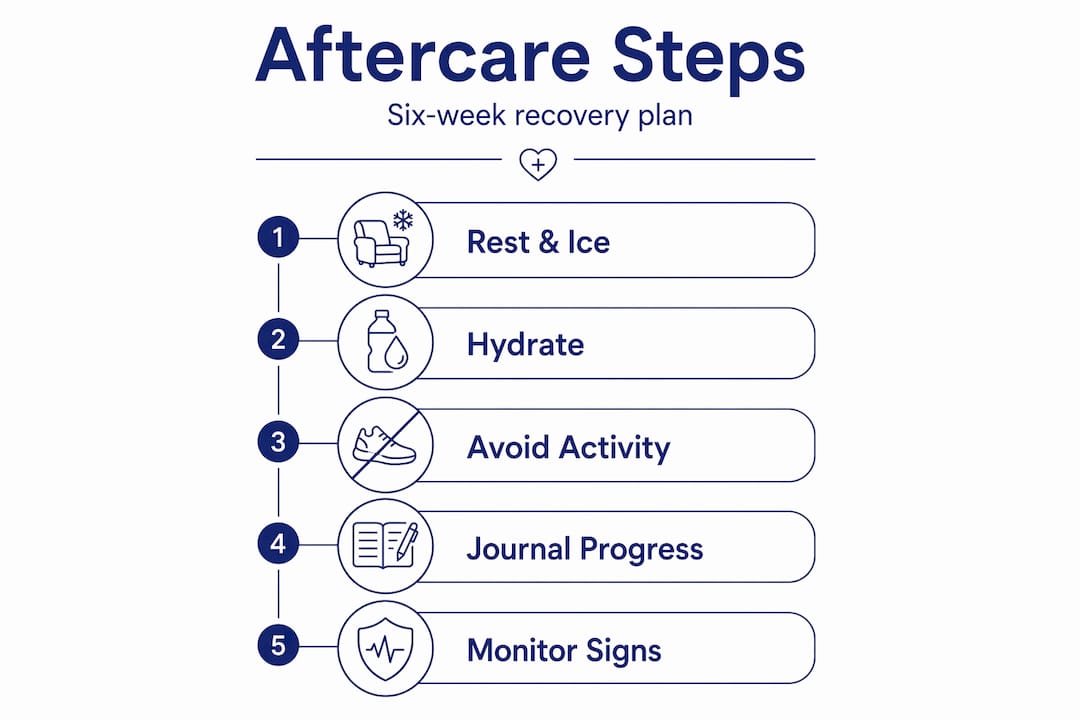
Now that you’ve gathered what you need, let’s walk through what to do in the first days and weeks after your procedure, step by step. The six-week window is widely recognized as the most critical phase for cell therapy patients receiving orthopedic injections.
Week-by-week recovery actions
-
Days 1 to 3: Rest and protect the site. Limit weight-bearing on the treated area. Avoid any activity that puts direct stress on the injection site. Apply cold packs in short intervals if swelling occurs. Stay well hydrated. Avoid alcohol and smoking, both of which can impair the healing environment.
-
Days 4 to 7: Begin gentle, passive movement. If your provider cleared you for it, start light range-of-motion exercises. These are slow, controlled movements within your comfortable range, not stretching or strengthening. Think of this as keeping circulation active without loading the tissue. Do not push through pain.
-
Weeks 2 to 3: Gradual return to daily activity. Most patients can resume low-demand activities such as slow walking, light household tasks, and sedentary work. Avoid heavy lifting, sustained standing, or anything that causes the treated area to ache. Following progressive activity restrictions is clinically supported across leading orthopedic protocols.
-
Weeks 4 to 5: Introduce structured rehabilitation. This is typically when physical therapy or guided home exercises begin. Focus on building stability and controlled strength around the treated joint. Work directly with a physical therapist who is informed about your biologic procedure. Strategies for improving joint mobility are especially relevant here.
-
Week 6: Reassess and communicate. Schedule a follow-up appointment with your provider. Report your progress honestly. This appointment shapes your next phase, whether you continue rehabilitation, modify intensity, or begin returning to more demanding activities.
| Recovery phase | Key actions | What to avoid |
|---|---|---|
| Days 1 to 3 | Rest, ice, hydrate | Strenuous activity, alcohol, NSAIDs |
| Days 4 to 7 | Gentle range of motion | Loading the joint, pushing through pain |
| Weeks 2 to 3 | Light daily activity | Heavy lifting, sustained exertion |
| Weeks 4 to 5 | Structured rehab starts | High-impact exercise, overtraining |
| Week 6 | Follow-up and reassess | Self-adjusting without provider input |
One of the most common mistakes we see is patients overestimating their progress and returning to sports or demanding work too soon. The treated tissue may feel better before it’s structurally ready. Patience in this phase protects the investment you’ve made. For context on what healing really involves, reviewing the science behind joint pain recovery can help you manage expectations realistically.
Pro Tip: Keep your recovery journal active through all six weeks. Document pain levels on a scale of 1 to 10 each morning and evening, note any new sensations, and write down questions as they arise. This record becomes invaluable at your follow-up appointment.
What to expect: Monitoring, troubleshooting, and adjusting your plan
With your daily and weekly actions underway, monitoring your body’s response helps you adjust if needed. Knowing the difference between normal healing and a warning sign can reduce anxiety and keep you safe.

Normal post-procedure responses
It’s common to experience mild to moderate soreness at the injection site for several days. Some swelling, warmth, or stiffness in the treated joint is expected as your body responds to the procedure. This localized inflammation is part of the healing process and typically peaks in the first 48 to 72 hours, then gradually subsides.
You might also notice a temporary increase in pain before improvement begins. This is sometimes called a “flare response” and is a recognized short-term reaction to biologic injections. It does not mean the therapy failed.
Warning signs that require immediate contact with your provider
- Fever above 101°F that develops within the first week
- Rapidly worsening pain that significantly exceeds your initial post-procedure soreness
- Visible redness, warmth, and swelling spreading beyond the injection site
- Pus, discharge, or unusual odor at or near the injection area
- Numbness or tingling in an unexpected area following a joint injection
- Loss of mobility that was present before the procedure
Contact your provider immediately if any of these signs appear. Do not wait for a scheduled appointment.
Important distinction: If you are receiving a hematopoietic stem cell transplant (HSCT) rather than an orthopedic biologic injection, aftercare is clinically managed differently, involving structured hospital-based or specialist follow-up, lab monitoring, and more intensive protocols over days and weeks. This guide primarily addresses outpatient orthopedic injection aftercare. If you are an HSCT patient, your care team will provide a separate, personalized monitoring plan.
Understanding the full range of evidence and risks associated with cell therapy helps set realistic expectations and promotes proactive communication with your provider. We also recommend reviewing resources on lasting relief with cell therapy to better understand why early aftercare decisions can shape long-term outcomes.
Why aftercare isn’t ‘one-size-fits-all’: The clinic and research perspective
As you personalize your recovery plan, it’s important to understand why clinics may recommend slightly different steps, and what to ask to ensure your aftercare fits your needs.
The variation in aftercare protocols is not random. It reflects the reality that musculoskeletal biologic therapies are still evolving in terms of standardization. The specific cell product used, how it was processed, the concentration, and the injection method all influence how recovery should be managed. A clinic using one type of mesenchymal stem cell product may reasonably recommend different restrictions than a clinic using a different preparation.
Additionally, no universally accepted biologic therapy standards exist across the industry. Many benchmarks are set by individual clinics based on their clinical experience, the research they follow, and the regulatory framework they operate within. This is not necessarily a red flag. It’s simply the current state of a rapidly developing field.
What this means for you as a patient
- Ask your clinic which specific cell product was used and whether there are product-specific aftercare recommendations available
- Request the rationale behind key restrictions, such as why certain medications are avoided or why activity resumes at a particular time
- Ask whether your protocol follows published clinical research or internal practice standards, and what the reasoning is either way
- Bring your written aftercare plan to a follow-up visit and review any questions that came up during the first two weeks
- Do not compare your protocol to what another patient experienced; different procedures, products, and patient profiles mean different recommendations
Exploring the range of regenerative medicine types can give you a clearer picture of how procedure differences translate to different aftercare needs.
Pro Tip: Before leaving your procedure appointment, ask your provider one direct question: “What is the single most important thing I can do in the next 72 hours to protect this treatment?” The answer will tell you a lot about their clinical priorities and give you a concrete starting point.
The real truth: What patients should demand (but rarely get) in aftercare advice
Having explored the science and recommendations, we want to offer a frank take on what actually makes a difference in patient recovery, based on real-world practice.
Here it is plainly: most aftercare protocols are not built on a foundation of rigorous, large-scale clinical trials. They are built on clinical judgment, accumulated experience, and reasonable extrapolation from related fields. That is not a criticism. It is simply the honest state of regenerative medicine right now. The science of healing with biologic therapies is advancing quickly, but the formal, standardized aftercare guidelines have not kept pace.
What this means in practice is that patients who communicate clearly and consistently with their care team consistently do better than patients who don’t. Not because they’re smarter or more disciplined, but because they get answers. They flag early warning signs before they become complications. They ask about activity modifications when life gets in the way. They return to their provider when something feels off rather than waiting and hoping.
We see the biggest recovery setbacks in patients who receive their aftercare instructions, feel uncertain about a particular step, say nothing, and then either overdo it or disengage from their protocol entirely. Both extremes cost them results. Silence is genuinely the biggest risk in aftercare.
The solution isn’t complicated. It’s asking detailed questions. It’s reading the material provided carefully enough to form questions in the first place. It’s treating your provider as a partner rather than just a technician who performed a procedure. If you want to understand what real evidence shows about how stem cells heal joints, bring that curiosity to your appointments. Providers respond positively to engaged patients, and engaged patients get more thorough answers.
The patients who get the best long-term results from cell therapy are not always the ones with the easiest cases. They’re the ones who stayed consistent, communicated openly, and treated aftercare as a genuine extension of the treatment itself.
Get expert-guided recovery support in North Texas
If you’re ready to take the next step toward recovery, or looking for a clinic that combines clinical rigor with personalized aftercare, Nortex Tissue Regeneration is here to help. Our team specializes in stem cell therapy in North Texas, and we build aftercare into every treatment plan from day one, not as an afterthought. We understand that your results depend on what happens in the weeks after your procedure just as much as the procedure itself. Whether you need guidance on activity restrictions, help interpreting your recovery timeline, or a follow-up consultation to reassess your progress, Nortex Tissue Regeneration provides evidence-aware, patient-focused support every step of the way. Book a consultation today and let us help you recover with confidence.
Frequently asked questions
How soon can I return to work after stem cell therapy?
Most patients can resume sedentary work within a few days of their procedure, but heavy lifting should be avoided for at least four weeks to protect the healing tissue.
Are there activities I must avoid after therapy?
Yes, strenuous exercise, running, and heavy lifting are typically restricted during the initial recovery period. Progressive activity restrictions are specified by most clinics and should be followed as directed by your physician.
How will I know if something is wrong post-procedure?
Contact your doctor immediately if you develop fever, rapidly worsening pain, unusual spreading redness, or any signs of infection. Structured monitoring and follow-up are essential components of safe cell therapy recovery.
Is aftercare the same for all types of stem cell therapy?
No. Aftercare varies across practices and depends on the specific cell product, injection site, and your individual health profile. Always follow the guidance your specific provider gives you rather than a general protocol.