

When you’re dealing with a torn tendon, a worn joint, or lingering pain from a sports injury, most people assume the only paths forward are surgery or extended rest. That assumption keeps a lot of North Texans stuck longer than they need to be. PRP and MSC therapies act as biologic adjuncts in musculoskeletal rehabilitation, with effects shaped by how each therapy is prepared and integrated with your recovery plan. This guide breaks down what regenerative therapy actually is, what the current evidence shows, and how to decide whether it belongs in your recovery.
Table of Contents
- What is regenerative therapy, and how does it work?
- How effective is regenerative therapy after an injury?
- Why outcomes differ: Factors that influence success
- Practical steps: What to ask before starting regenerative therapy
- The truth about regenerative therapy: What most clinics won’t tell you
- Considering regenerative therapy in North Texas?
- Frequently asked questions
Key Takeaways
| Point | Details |
|---|---|
| Personalized therapy matters | Your outcomes improve when regenerative treatments and rehabilitation are tailored to your injury. |
| Expect gradual results | Most pain relief and functional gains from PRP or stem cell therapies emerge over several months. |
| Ask about protocols | Success with PRP or stem cells depends on therapy preparation, dosing, and integration, not marketing claims. |
| No one-size-fits-all | Results can differ widely between individuals based on injury type and therapy specifics. |
What is regenerative therapy, and how does it work?
Regenerative therapy covers a range of biologic treatments designed to support your body’s natural repair processes rather than replacing them surgically. The two most studied approaches in musculoskeletal care are Platelet-Rich Plasma (PRP) and Mesenchymal Stem/Stromal Cell (MSC) therapy. Understanding what each one does at a biological level helps you ask better questions and set realistic expectations.
PRP (Platelet-Rich Plasma) is made from your own blood. A sample is drawn, then spun in a centrifuge to concentrate the platelets far above their normal levels in whole blood. Those concentrated platelets release growth factors that modulate inflammation and support tissue repair when injected at an injury site. This is not a drug. It is a preparation of your own biology, delivered with precision.
MSC therapy works differently. Mesenchymal stem or stromal cells, typically sourced from bone marrow or adipose (fat) tissue, are introduced into damaged areas. Importantly, these cells do not simply transform into new cartilage or tendon. Their primary benefit comes from paracrine signaling, meaning they release molecules that communicate with surrounding tissue, calming inflammation and prompting the body’s own repair cells to become more active.
“PRP is a concentrated source of platelet-derived growth factors that modulate inflammation and support tissue repair, while MSCs mostly act via paracrine signaling rather than direct tissue replacement.” — Platelet-rich plasma and stem cell therapies for musculoskeletal rehabilitation
Here is a quick comparison of the two therapies at the biological level:
| Feature | PRP | MSC therapy |
|---|---|---|
| Source | Patient’s own blood | Bone marrow or fat tissue |
| Primary mechanism | Growth factor delivery | Paracrine (cell signaling) |
| Main clinical use | Tendon, joint, soft tissue | Cartilage, joint degeneration |
| Preparation time | 30 to 60 minutes in clinic | Variable by source |
| Regulatory status | Well established | Evolving standards |
Key biological effects you should know:
- Platelet activation triggers the release of PDGF, TGF-beta, VEGF, and other growth factors that accelerate cellular repair
- Anti-inflammatory modulation from PRP can reduce the chronic low-grade inflammation that slows healing in tendons and joints
- Paracrine effects from MSCs recruit surrounding repair cells, reduce scar tissue formation, and promote healthier tissue remodeling
- Preparation variables such as leukocyte content, platelet concentration, and activation method (calcium chloride vs. thrombin) significantly alter what the final product actually does
Explore the regenerative medicine types available for joint pain to understand how these therapies compare against one another in real clinical settings.
The bottom line: neither PRP nor stem cell therapy is a magic injection. Their effectiveness depends heavily on what goes into the preparation, where and how they are delivered, and what rehabilitation supports them afterward.
How effective is regenerative therapy after an injury?
With the science clarified, it’s time to ask the harder question: do these therapies actually work?
The honest answer is that the evidence is promising but nuanced. For PRP specifically, a 2025 updated systematic review and meta-analysis found that PRP shows statistically significant pain reduction versus active drugs and placebo in chronic noncancer pain, but the durability of that effect is time-dependent. In other words, PRP works, but how long it works and how well it works varies based on multiple factors.
Here is how PRP and stem cell therapy compare across key outcomes:
| Outcome measure | PRP evidence | MSC/stem cell evidence |
|---|---|---|
| Pain reduction | Statistically significant vs. placebo | Moderate, less robust data |
| Function improvement | Consistent in tendon and joint cases | Promising for cartilage defects |
| Effect durability | Most pronounced at 3+ months | Variable, longer-term data limited |
| Safety profile | Strong, low adverse event rate | Generally safe, protocol-dependent |
| Best-suited conditions | Tendinopathy, OA, soft tissue | Advanced OA, cartilage injury |
What patients can realistically expect:
- Early weeks (0 to 4 weeks): Mild soreness at the injection site is common. Some patients notice a slight reduction in sharp pain, but major changes are rare at this stage.
- One to three months: Most patients begin to feel meaningful improvement. Inflammation calms, mobility often increases, and daily activities become easier.
- Three months and beyond: This is when chronic pain PRP results tend to be most measurable. Research consistently shows the greatest benefit at this follow-up window.
- Six months and beyond: Some patients maintain significant relief; others may benefit from a second treatment depending on their condition.
For stem cell therapies, the evidence base is still developing. PRP is best used as adjunctive support for selected musculoskeletal conditions, and the same principle applies to MSC treatments. Both work best when matched carefully to your specific injury and paired with a structured rehab program.
Pro Tip: Ask your provider what the research says specifically for your condition, not just regenerative therapy in general. The evidence for PRP in patellar tendinopathy, for example, differs from the evidence for knee osteoarthritis. The difference matters.
Understanding how PRP vs traditional drugs compare can also help you frame your expectations before your first consultation. And if you’ve heard conflicting reports from friends or online forums, it’s worth learning why PRP outcomes vary so widely from person to person.
Why outcomes differ: Factors that influence success
Readers now understand what these therapies are and the general evidence. So why do results seem unpredictable from patient to patient?
No single protocol fits all patients in regenerative medicine. Differences in preparation, dosing, and patient selection are the primary reasons outcomes can be inconsistent even within the same condition. This is not a weakness of the therapy itself. It reflects the biological complexity involved and the importance of individualized care.
The major variables that shape your outcome include:
- Leukocyte content in PRP: Leukocyte-rich PRP (LR-PRP) contains white blood cells and is more inflammatory, which may benefit some tendon injuries but worsen joint conditions. Leukocyte-poor PRP (LP-PRP) tends to be preferred for knee osteoarthritis.
- Platelet concentration: More platelets is not always better. Concentration levels must match the injury type and the biology of the target tissue.
- Activation method: Some protocols activate PRP with calcium chloride or thrombin before injection; others rely on the body to activate it naturally. Activation can influence how quickly and potently growth factors are released.
- Injection technique: Ultrasound-guided delivery places the therapy precisely where it needs to go. Blind injections, even with skilled hands, are less accurate.
- Number of injections: A single treatment may not be sufficient. Some conditions benefit from a series of two or three injections spaced several weeks apart.
- Rehab integration: Outpatient success factors consistently point to physical therapy as a multiplier. Regenerative therapy stimulates repair; rehab ensures the tissue heals in a functional, load-bearing pattern.
Patient selection and injury type are critical factors, with some cases responding significantly better than others. For example, early to moderate knee osteoarthritis typically responds better to PRP than end-stage joint degeneration, where structural loss is too extensive for biologic support alone.
When we evaluate a new patient at Nortex Tissue Regeneration, we are not just choosing a therapy. We are designing a protocol. The preparation details, the delivery method, the timing, and the rehab plan are all part of the same clinical decision.
Pro Tip: Before committing to any regenerative treatment, ask the clinic these specific questions: Do you use leukocyte-rich or leukocyte-poor PRP, and why? How do you confirm injection accuracy? What rehab protocol do you pair with treatment? A provider who can answer these clearly is one worth trusting.
How rehab integration improves joint mobility and functional recovery is a topic worth exploring before you start any regenerative program. Understanding the role of movement in healing can significantly improve your results.

Practical steps: What to ask before starting regenerative therapy
Having learned why results can be so variable, here is a framework to help you make your best decision with confidence.
Step-by-step decision guide:
- Confirm your diagnosis first. Regenerative therapy works best when the injury is clearly identified. MRI or ultrasound imaging helps establish baseline severity and confirms whether biologic support is appropriate.
- Ask specifically about your condition. Good providers will cite research relevant to your injury, not just general PRP studies. Expectation-setting, clarity on biologic formulation, and alignment with an evidence-based rehab plan are benchmarks you should hold your provider to.
- Understand the preparation protocol. Ask whether the clinic uses ultrasound guidance, what platelet concentration they target, and how they determine leukocyte content.
- Clarify the rehab component. Regenerative therapy without structured rehabilitation is an incomplete plan. Confirm that your provider offers or coordinates with a physical therapist who understands biologic treatments.
- Set realistic timelines. Most meaningful improvement takes 8 to 12 weeks minimum. If a clinic promises dramatic results in days, treat that as a warning sign.
- Ask about follow-up assessments. Providers who measure outcomes, track your progress, and adjust your plan are practicing evidence-based care. This is what you deserve.
Questions to ask your provider before starting:
- What evidence supports this therapy specifically for my injury?
- How is your PRP prepared, and what concentration do you target?
- Will injections be ultrasound-guided?
- How many treatments do you anticipate, and what is the spacing?
- What physical therapy or movement protocol supports this treatment?
- How will we measure whether the treatment is working?
Pro Tip: Be cautious of any clinic that promises guaranteed outcomes, avoids discussing protocol specifics, or uses language like “revolutionary cure.” Regenerative medicine is an evolving field, and credible providers speak in terms of evidence, probabilities, and individualized care rather than certainties.
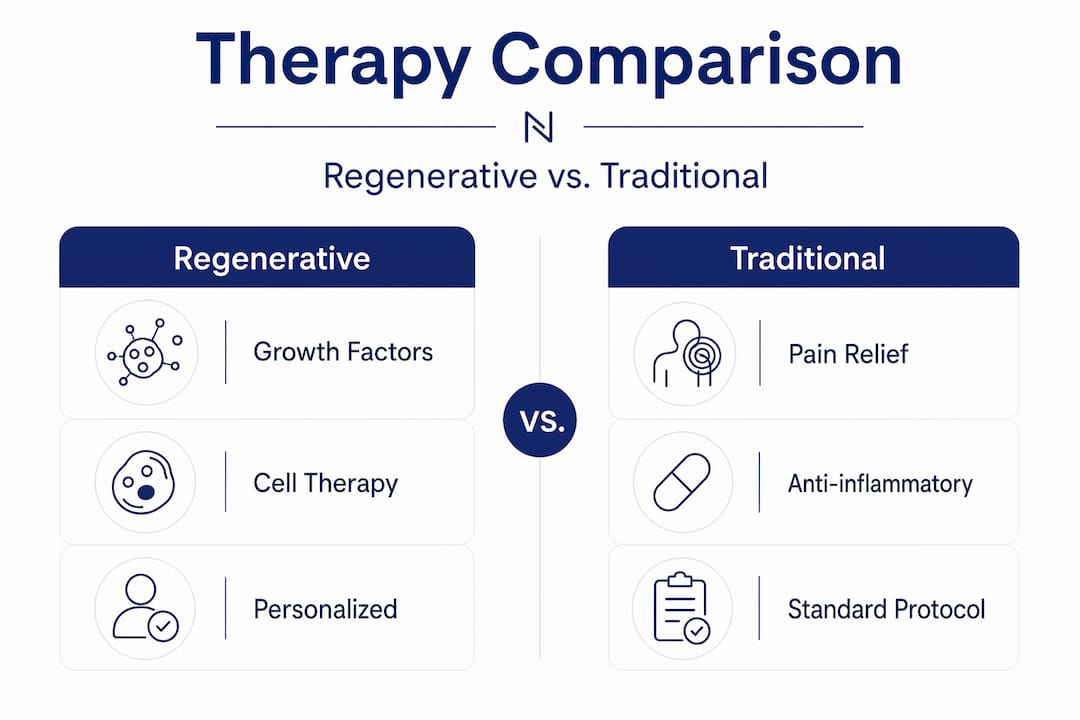
Reviewing therapy options compared side by side is a useful step before your first appointment so you arrive informed and ready to ask the right questions.
The truth about regenerative therapy: What most clinics won’t tell you
With all the practical steps in place, let’s set aside the hype and focus on what actually separates success from disappointment in regenerative care.
The marketing around PRP and stem cell therapy has outpaced the science in many corners of the industry. You will see clinics advertising “one-shot solutions,” “100% natural healing,” and “stem cells that rebuild your joint.” These claims are not just oversimplified. They are often misleading in ways that set patients up for disappointment.
Here is the reality as we see it. PRP works through local growth factor delivery, and MSCs work primarily through paracrine signaling. The label on the treatment matters far less than the specifics of how it was prepared and delivered. Two clinics can both call their product “PRP” and be offering something biologically quite different based on processing methods.
The patients we see achieve the best outcomes are those who received carefully selected protocols matched to their specific injury, were supported through active rehabilitation, and had realistic timelines communicated to them from the start. Not the ones who chased the most aggressive marketing or the biggest promise.
This is also why why details matter in PRP therapy is one of the most important topics we discuss with patients. The difference between a leukocyte-rich and leukocyte-poor preparation, or between a guided and an unguided injection, can be the difference between meaningful relief and frustration.
Our honest advice: seek providers who explain their protocols, cite their evidence, and measure your results. If a clinic avoids those conversations, it is telling you something important about the care you will receive.
Considering regenerative therapy in North Texas?
If you’re exploring your recovery options, specialized support in regenerative therapy is available right here in North Texas. At Nortex Tissue Regeneration, we offer evidence-based, individualized stem cell therapy and PRP therapy protocols designed around your specific injury, your goals, and your timeline. We don’t apply the same plan to every patient, because no two recoveries are the same. Whether you’re dealing with a chronic joint condition, a stubborn sports injury, or post-surgical pain that simply won’t resolve, we take the time to assess your case and recommend what the evidence actually supports. Take the next step and regenerate your body with a team that treats your recovery as a clinical priority, not a sales opportunity.
Frequently asked questions
How long does it take for PRP therapy to relieve pain after injury?
Most patients experience the greatest benefit after 3 months, with the pain-reducing benefits more pronounced at follow-up beyond that window rather than in the first few weeks after treatment.
Is regenerative therapy safe after musculoskeletal injury?
PRP and stem cell therapies are considered safe when performed by qualified providers, though outcomes and safety depend on preparation technique and patient selection, meaning not every case is automatically a good candidate.
Can I combine physical therapy with regenerative treatments?
Yes, and you should. Clinical effect is mediated by how therapy is integrated with rehabilitation, so pairing regenerative injections with a structured physical therapy program consistently improves outcomes.
Why do regenerative therapy results differ between people?
Heterogeneity in preparation and patient selection drives outcome differences, meaning your results will depend on how the therapy was prepared, your injury type, and how well your recovery plan was designed and followed.
Recommended
- How Regenerative Treatments Improve Joint Mobility
- Can PRP Help Post-Surgical Healing? A Boost for Recovery – Nortex Tissue Regeneration
- PRP for Sports Injuries: How Athletes Use Platelet Therapy to Recover Faster – Nortex Tissue Regeneration
- Outpatient Regenerative Therapy: Evidence, Options, and Real Outcomes