Tissue healing is defined as the biological process by which the body repairs injured or damaged tissue to restore its structural integrity and function. This process is not passive. It is a coordinated sequence of cellular events that, when working correctly, prevents infection, restores movement, and protects long-term health. When it fails or stalls, the consequences range from chronic pain to fibrosis to disease. Understanding why tissue healing matters is the first step toward making smarter decisions about your recovery, whether you are dealing with a sports injury, a surgical wound, or a chronic condition that never quite resolves.
Why tissue healing matters: the four phases explained
Tissue healing follows four strict sequential phases. Failure to progress through each one leads to chronic wounds with serious health risks. Each phase has a specific biological job, and the body cannot skip steps.
1. Hemostasis begins within seconds of injury. Blood vessels constrict, platelets aggregate, and a clot forms to stop bleeding. This clot also releases growth factors that signal the next phase to begin. Without effective hemostasis, the wound environment stays unstable and healing cannot advance.
2. Inflammation follows immediately. White blood cells flood the area to clear bacteria and debris. This phase gets a bad reputation, but controlled inflammation is necessary. Balanced inflammation and adequate blood flow are critical for efficient tissue repair. Excess or deficient inflammation both hinder recovery, which is why anti-inflammatory medications taken too early can actually slow healing.
3. Proliferation is where rebuilding happens. Fibroblasts produce collagen, new blood vessels form through angiogenesis, and the wound contracts. Coordinated cellular signaling and angiogenesis are essential here for nutrient delivery and tissue rebuilding. This phase can last several weeks, and patients often feel better before it is complete, which leads to premature return to activity.
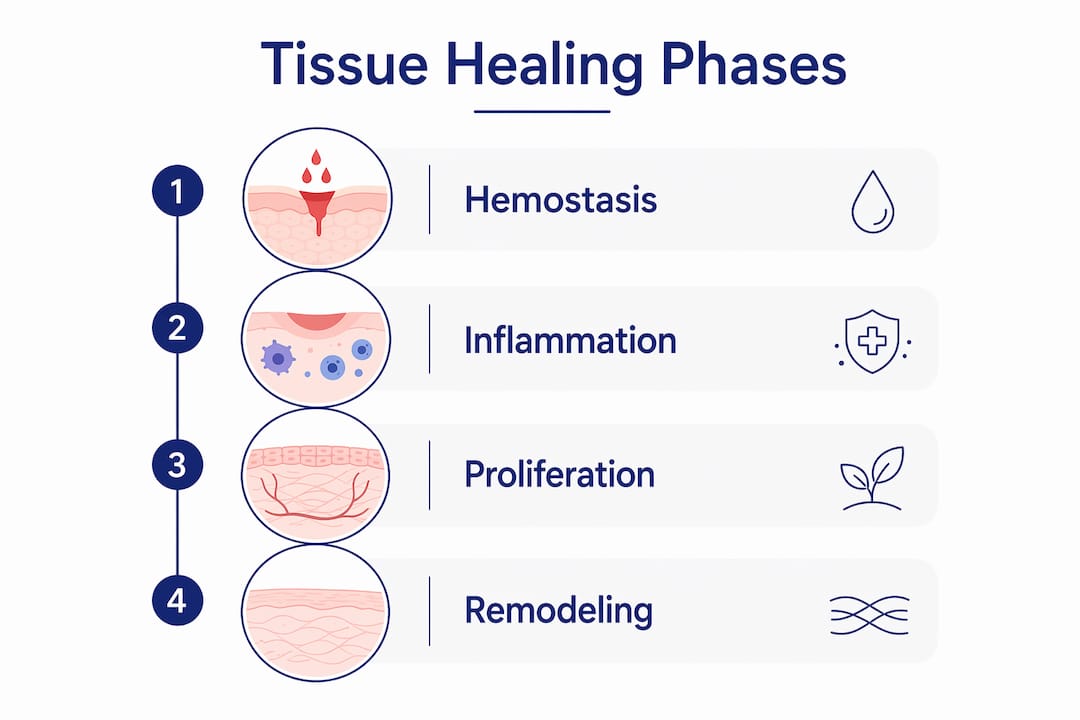
4. Remodeling is the final and longest phase, sometimes lasting one to two years. Collagen fibers reorganize to increase tensile strength. The tissue never returns to its original state. Scar tissue typically reaches only about 80% of original strength and has reduced elasticity compared to uninjured tissue. That gap matters enormously for athletes, manual workers, and anyone who depends on full physical function.
Pro Tip: If you feel “healed” after a few weeks, you are likely still in the proliferation phase. Returning to full load too early disrupts collagen organization and increases re-injury risk.
What factors influence how well your tissue heals?
Healing speed and quality vary significantly from one patient to the next. Clinical heterogeneity in healing response is driven by patient factors like age and metabolic risk, wound characteristics, and treatment protocols. No two recoveries look identical.
The factors that most consistently affect outcomes include:
- Age. Older tissue has slower cellular turnover and reduced growth factor production. Healing timelines lengthen with age, and the remodeling phase is often less complete.
- Nutrition. Collagen synthesis requires vitamin C, zinc, and adequate protein. Deficiencies in any of these directly impair the proliferation phase.
- Blood flow. Tissue with poor circulation, common in diabetes and peripheral artery disease, receives fewer nutrients and immune cells. This is a primary driver of non-healing wounds.
- Smoking. Nicotine constricts blood vessels and reduces oxygen delivery to healing tissue. Smokers consistently show slower wound closure and higher complication rates.
- Chronic illness. Conditions like diabetes, autoimmune disease, and obesity alter the inflammatory response and impair cellular signaling throughout all four phases.
- Stress and sleep. Cortisol suppresses immune function and slows tissue repair. Poor sleep reduces growth hormone release, which is critical for cellular regeneration.
- Medications. Corticosteroids, NSAIDs, and certain immunosuppressants can blunt the inflammatory phase when used at the wrong time, disrupting the healing sequence.
Emerging therapies are also changing what is possible. Near-infrared therapy using wavelengths of 700–850 nm over several sessions significantly improves wound healing and reduces pain. This approach works by stimulating mitochondrial activity in cells, increasing energy available for repair.
Pro Tip: Before any procedure or injury recovery, ask your care team to review your current medications. Some common drugs interfere with healing phases in ways that are easy to address if caught early.
How does impaired healing affect long-term health?
Poor tissue healing does not just mean a slower recovery. It sets the stage for conditions that can persist for years. Imperfect wound healing plays a key role in inflammatory diseases, fibrosis, and cancer development over time. That connection is often underappreciated by patients who think of a wound as a local, temporary problem.
Chronic wounds are the most visible consequence. These are wounds that fail to progress through the normal healing phases within a reasonable timeframe. They create an environment of persistent inflammation, bacterial colonization, and tissue breakdown. The annual economic burden of wound care in the US is approximately $50 billion. That figure reflects the scale of what happens when healing goes wrong at a population level.
Beyond open wounds, fibrosis and scar overgrowth interfere with normal tissue function and lead to functional impairment when healing is disrupted. Fibrosis replaces flexible, functional tissue with stiff collagen deposits. In joints, this reduces range of motion. In organs, it impairs function. In tendons and ligaments, it increases the risk of re-injury.
Persistent low-grade inflammation from poor healing drives chronic health issues. Pathological fibrosis limits joint function and is often overlooked until mobility is already significantly reduced. Addressing healing quality early is far more effective than managing fibrosis after it has established itself.
The long-term picture is clear. Patients who experience repeated incomplete healing cycles accumulate structural deficits that compound over time. A tendon that never fully remodeled, a joint that carries chronic low-grade inflammation, a scar that restricts movement. Each of these reduces quality of life in ways that are difficult to reverse.
| Consequence | Effect on health and function |
|---|---|
| Chronic wounds | Persistent infection risk, pain, and tissue loss |
| Pathological fibrosis | Reduced joint mobility and organ function |
| Scar tissue weakness | Only ~80% of original tensile strength restored |
| Persistent inflammation | Increased risk of inflammatory disease and cancer |
| Economic burden | Approximately $50 billion annually in US wound care costs |
What practical steps support optimal tissue healing?
Healing is an adaptive process. It reshapes tissue and affects functional recovery, requiring patient engagement well beyond passive rest. The patients who recover most fully are those who treat healing as an active responsibility, not something that simply happens to them.
The most evidence-supported steps include:
- Protect blood flow. Move gently and consistently. Prolonged immobility reduces circulation to healing tissue. Even light movement after injury promotes angiogenesis and nutrient delivery.
- Prioritize protein and micronutrients. Aim for adequate daily protein intake and include foods rich in vitamin C, zinc, and omega-3 fatty acids. These directly support collagen synthesis and inflammation regulation.
- Avoid smoking entirely during recovery. Nicotine’s effect on blood vessel constriction is not mild. It measurably delays wound closure and increases complication rates.
- Manage stress actively. Elevated cortisol suppresses the immune response needed for the inflammatory phase. Practices like structured breathing, adequate sleep, and reduced workload during recovery are not optional extras.
- Follow a graduated return to activity. Returning to full load before the remodeling phase is complete is one of the most common reasons for re-injury. Work with a physical therapist or clinician to time your return correctly.
- Consider regenerative medicine therapies. Platelet-Rich Plasma (PRP) therapy concentrates growth factors from your own blood and delivers them directly to the injury site, supporting the proliferation phase. Stem cell therapy introduces cells capable of differentiating into the tissue type being repaired. These approaches work with the body’s natural healing process rather than replacing it. You can read more about tissue repair therapies to understand which options may apply to your situation.
Healing quality also depends on understanding that the goal is not simply returning to baseline. Healing is an opportunity for adaptation, which requires conscious patient engagement with factors like circulation and nutrition. Patients who approach recovery this way often report better long-term function than they had before the injury.
Key Takeaways
Effective tissue healing requires active patient engagement across all four biological phases, supported by nutrition, blood flow, and appropriate medical care.
| Point | Details |
|---|---|
| Four phases are non-negotiable | Hemostasis, inflammation, proliferation, and remodeling must each complete for full recovery. |
| Scar tissue has limits | Healed tissue reaches only about 80% of original strength, requiring proactive rehabilitation. |
| Impaired healing drives disease | Poor healing contributes to fibrosis, chronic inflammation, and long-term disease risk. |
| Lifestyle factors are controllable | Nutrition, smoking cessation, sleep, and managed stress directly improve healing outcomes. |
| Regenerative therapies add support | PRP and stem cell therapy work with the body’s natural repair process to accelerate recovery. |
What I’ve learned about healing that most patients don’t expect
Felix here. After working alongside patients managing everything from sports injuries to degenerative joint conditions, the pattern I see most often is this: people underestimate how long healing actually takes, and they overestimate how much rest alone will accomplish.
The remodeling phase is where this misunderstanding does the most damage. A patient feels fine at six weeks. Pain is gone, swelling is down. They return to full activity. But the tissue is still reorganizing collagen, still building tensile strength. Loading it too hard at that point does not just slow things down. It can redirect the remodeling process in ways that produce weaker, less organized tissue.
What I’ve also found is that healing quality directly shapes long-term mobility and comfort. Patients who invest in the process, who manage their nutrition, who stay consistent with graduated movement, who address inflammation intelligently rather than suppressing it entirely, tend to have genuinely better outcomes years later. Not just faster recovery, but better function than they had before.
The other thing worth saying plainly: healing reshapes tissue in ways that affect the whole body, not just the injury site. Compensatory movement patterns develop when healing is incomplete. A poorly healed ankle changes how you load your knee. A stiff shoulder alters your spine mechanics. Treating healing as a local, temporary event misses the bigger picture entirely.
— Felix
How Nortextissueregeneration supports your tissue healing
At Nortextissueregeneration, we work with patients who are tired of managing pain without addressing what is actually happening in their tissue. Our approach centers on therapies that support the body’s own repair process. PRP therapy concentrates growth factors from your own blood and delivers them directly to the site of injury, giving the proliferation phase the biological signals it needs. Stem cell therapy goes further, introducing cells that can participate in rebuilding damaged tissue. Both treatments are non-surgical, require minimal downtime, and are designed around your specific condition and healing timeline. If you are dealing with a chronic injury or a condition that has not responded to standard care, these therapies are worth a serious conversation.
FAQ
What is tissue healing and why does it matter?
Tissue healing is the biological process that restores structural integrity and function to injured tissue through four sequential phases. Without effective healing, injuries become chronic, and long-term complications including fibrosis and inflammatory disease become more likely.
How long does tissue healing take?
The timeline varies by injury type, patient age, and overall health, but the remodeling phase alone can last one to two years. Feeling pain-free does not mean healing is complete.
What slows down tissue healing the most?
Smoking, poor nutrition, uncontrolled blood sugar, chronic stress, and premature return to activity are the most consistent factors that delay or impair healing outcomes.
Can regenerative medicine therapies improve healing?
PRP therapy and stem cell therapy both support the body’s natural repair process by delivering growth factors and regenerative cells directly to the injury site. These are non-surgical options suited for patients with chronic or incomplete healing.
What happens if tissue healing is incomplete?
Incomplete healing leads to scar tissue with reduced strength and elasticity, persistent inflammation, and increased risk of re-injury. Over time, imperfect healing contributes to fibrosis and chronic disease development.