
Knee regeneration is defined as the biological process of restoring damaged knee cartilage and tissue using therapies that work with the body’s own healing mechanisms rather than replacing the joint with artificial parts. The field draws on three main approaches: Platelet-Rich Plasma (PRP) therapy, stem cell treatments, and scaffold-supported cartilage repair. These methods aim to rebuild tissue at the cellular level, reduce pain, and preserve natural joint function. For patients facing chronic knee pain or early cartilage loss, understanding how these therapies work is the first step toward making an informed decision.
What is knee regeneration and how does it differ from joint replacement?
Knee regeneration, more precisely called cartilage restoration or regenerative joint therapy, targets the biological repair of damaged tissue rather than its mechanical substitution. A total knee replacement removes the damaged joint surfaces and installs prosthetic components. Regenerative approaches attempt to stimulate or deliver new tissue growth within the existing joint structure. Cartilage restoration is best understood as a knee preservation strategy, designed to delay or avoid replacement surgery by maintaining natural joint function.
This distinction matters clinically. Knee cartilage has almost no blood supply of its own, which means it cannot repair itself the way muscle or bone can. Once cartilage wears down, the body does not spontaneously rebuild it. Regenerative therapies address this limitation directly by delivering biological agents, growth factors, or stem cells to the damaged site to prompt new tissue formation.

The goal is not cosmetic or symptomatic alone. Preserving the original joint architecture protects surrounding structures, maintains normal movement mechanics, and reduces the long-term burden of progressive degeneration. We often see patients who come in after years of managing pain with anti-inflammatories, only to learn that earlier intervention with regenerative therapy could have slowed the damage considerably.
What are the main knee regeneration techniques?
Several well-documented techniques form the core of knee cartilage regeneration today. Each works through a different biological pathway, and the right choice depends on the size of the cartilage defect, the patient’s age, and the condition of the surrounding joint.
- Platelet-Rich Plasma (PRP) therapy: PRP is produced by concentrating platelets from the patient’s own blood. These platelets release growth factors that reduce inflammation and signal tissue repair. PRP is most effective for early cartilage damage and mild to moderate osteoarthritis, where the joint environment can still support healing.
- Stem cell therapy: Stem cells can be sourced from bone marrow aspirate concentrate (BMAC) or adipose tissue. Once introduced into the joint, they can differentiate into cartilage-producing cells called chondrocytes and secrete anti-inflammatory signals. Bone marrow sources are currently the most studied for knee applications.
- Scaffold-supported cartilage repair: Scaffolds protect fragile cells and growth factors from mechanical stress during the early healing phase. Without a scaffold, newly delivered cells are vulnerable to being crushed or washed away before they can integrate. Hyaluronic acid scaffolds are a common delivery system used in combination with BMAC and PRP.
- Combined one-step procedures: A clinical study involving 165 patients used BMAC on a hyaluronic acid scaffold combined with intraarticular PRP for full-thickness cartilage lesions. At one year, 50% of patients showed excellent outcomes both clinically and on MRI imaging.
The biological environment matters as much as the therapy itself. Delivering stem cells into an inflamed, mechanically unstable joint produces far worse results than the same treatment in a well-prepared joint.
Pro Tip: Ask your specialist about treatment timing. Regenerative therapies work best when cartilage damage is moderate rather than end-stage. Earlier intervention consistently produces better tissue integration.
What does current research say about effectiveness and safety?
The evidence base for knee regeneration therapies is growing, though it is not yet uniform across all methods. Understanding what the research actually shows helps set realistic expectations.
A Cochrane review found that stem cell injections may slightly improve pain and function in knee osteoarthritis compared to placebo, based on meta-analyses involving 168 participants. The certainty of that evidence is rated as low. Serious adverse events were infrequent, which is a meaningful safety signal, but long-term structural benefits remain unclear.
Systematic reviews similarly report small symptom improvements from stem cell therapy but note uncertain effects on joint structural progression or quality of life over time. This does not mean the treatments are ineffective. It means the research is still catching up with clinical practice, and patients should approach outcome claims with appropriate nuance.
On the horizon, a Stanford Medicine study published in november 2025 showed that inhibiting the 15-PGDH protein regenerated functional cartilage in aging human tissue samples treated for one week and protected against arthritis development in mice. This points toward future pharmacological treatments that could work alongside or instead of injection-based therapies.
| Treatment | Evidence level | Typical outcome | Known risks |
|---|---|---|---|
| PRP therapy | Moderate | Pain reduction, improved function | Mild injection-site reaction |
| Stem cell (BMAC) | Low to moderate | Small pain and function gains | Infrequent serious adverse events |
| Scaffold + BMAC + PRP | Emerging | 50% excellent outcomes at one year | Procedure-related infection risk |
| 15-PGDH inhibition | Preclinical | Cartilage regeneration in tissue models | Under investigation |
Safety profiles across PRP and BMAC-based treatments are generally favorable. Infection risk exists with any injection procedure but is low when performed under sterile clinical conditions. Theoretical concerns about uncontrolled cell growth with stem cell therapies have not materialized in current clinical data, though long-term surveillance continues.
How do patient factors affect knee regeneration outcomes?
Regenerative therapy does not work in isolation. The condition of the whole joint determines whether new tissue can survive and integrate. This is one of the most underappreciated factors in patient education about tissue regeneration for joint pain.
Successful cartilage regeneration requires a stable joint environment. Poor alignment or ligament instability increases the failure risk of regenerated tissue regardless of how well the biological therapy performs. A patient with a torn ACL and significant varus malalignment is not a good candidate for cartilage regeneration until those mechanical issues are addressed.
Key factors a specialist evaluates before recommending regenerative therapy include:
- Cartilage defect size and depth: Smaller, focal defects respond better than widespread degeneration across the entire joint surface.
- Ligament and meniscus integrity: Instability causes abnormal shear forces that tear apart newly formed tissue before it can mature.
- Joint alignment: Varus or valgus malalignment concentrates load on specific compartments, accelerating wear on regenerated tissue.
- Patient age and activity level: Younger, active patients with focal defects tend to show better outcomes than older patients with diffuse osteoarthritis.
- Systemic health: Conditions like uncontrolled diabetes or inflammatory arthritis affect cell survival and healing capacity.
Therapeutic approaches are increasingly personalized using defect morphology and joint biomechanics to select the most appropriate regenerative method. This shift away from one-size-fits-all protocols is one of the most significant advances in the field.
Pro Tip: Before any regenerative procedure, ask for a full biomechanical assessment. Addressing alignment or instability first is not a delay in treatment. It is the treatment working properly.
What can patients expect during and after knee regeneration?
Knee cartilage regeneration is a gradual biological process, not an immediate mechanical fix. New cartilage needs a maturation period before it can bear normal joint loads. Patients who understand this from the start tend to follow through with rehabilitation and report better satisfaction with outcomes.
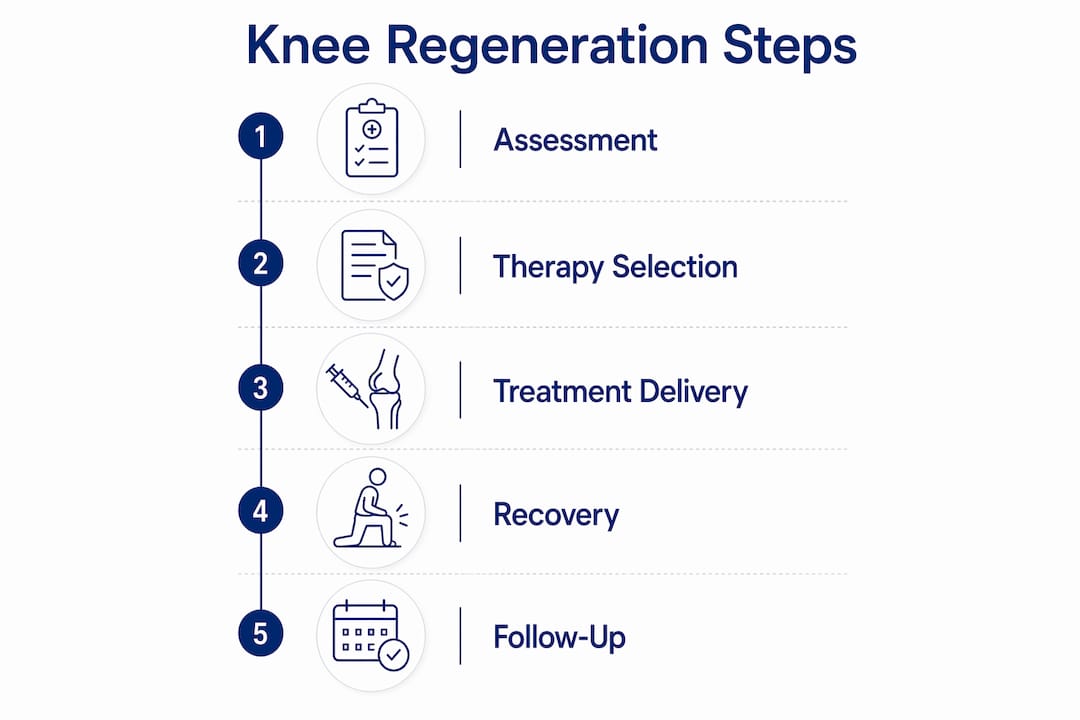
A typical post-treatment timeline looks like this:
- Weeks 1–4: Protected weight-bearing or activity restriction. The goal is to allow initial cell adhesion and early tissue formation without mechanical disruption.
- Weeks 4–8: Gradual reintroduction of low-impact movement. Physical therapy begins to restore range of motion and muscle support around the joint.
- Months 3–6: Progressive loading. Cartilage tissue continues to mature and integrate. Patients often notice gradual pain reduction and improved function during this phase.
- Months 6–12: Full functional assessment. MRI imaging may be used to evaluate tissue quality and integration. Return to sport or high-demand activity is assessed individually.
- Beyond 12 months: Ongoing joint preservation focus. Specialist follow-up monitors for any signs of degeneration and guides long-term activity modification.
Response varies based on lesion size, patient health, and how well the joint environment was prepared before treatment. Patients with smaller, focal defects in stable joints typically see the most consistent results. Those with more extensive wear may experience meaningful pain relief but incomplete structural restoration.
The contrast with total knee replacement is worth stating plainly. A replacement provides a new mechanical surface immediately but involves significant recovery, carries prosthetic lifespan limitations, and removes the option of future regenerative approaches. Regenerative therapy preserves options. It is a slower path, but for the right patient, it is a more biologically sound one.
Key Takeaways
Knee regeneration works best when biological therapy, joint stability, and patient selection are addressed together rather than in isolation.
| Point | Details |
|---|---|
| Regeneration vs. replacement | Regenerative therapy preserves the natural joint; replacement removes it permanently. |
| Core techniques | PRP, stem cell (BMAC), and scaffold-supported repair each target different stages of cartilage damage. |
| Evidence is promising but limited | Research shows small pain and function gains; long-term structural outcomes need more study. |
| Joint environment is critical | Instability or malalignment causes regenerated tissue to fail regardless of biological success. |
| Recovery takes time | New cartilage matures over 6–12 months; realistic expectations improve patient outcomes. |
What I’ve learned about knee regeneration after years in this field
Felix here. The question I get most often from patients is some version of: “Is this actually going to work?” My honest answer is always the same. It depends on whether you are the right candidate, and whether the whole joint has been properly evaluated before treatment begins.
What I’ve found is that the patients who do best are not necessarily the ones with the least damage. They are the ones who come in with realistic expectations, commit to the rehabilitation process, and work with a team that addresses the full picture, not just the cartilage defect in isolation. We’ve seen patients with moderate lesions achieve excellent outcomes because every factor was managed carefully. We’ve also seen patients with smaller defects struggle because underlying instability was overlooked.
The research landscape is genuinely encouraging. The Stanford work on 15-PGDH inhibition is the kind of finding that could change how we approach cartilage loss pharmacologically within the next decade. PRP and BMAC protocols are becoming more refined. Scaffold technologies are improving. But none of that replaces the clinical judgment required to match the right therapy to the right patient at the right time.
My caution to anyone reading this: be skeptical of any clinic promising guaranteed cartilage regrowth or complete reversal of arthritis. The biology does not support those claims. What regenerative therapy can genuinely offer is meaningful pain reduction, improved function, and the possibility of preserving your natural joint for longer. That is worth pursuing. It just requires honesty about what the process involves.
— Felix
Nortextissueregeneration: advanced knee regeneration care in North Texas
Nortextissueregeneration specializes in non-surgical regenerative treatments for patients dealing with knee pain, cartilage damage, and joint degeneration. The clinic offers stem cell therapy using bone marrow aspirate concentrate, PRP therapy for tissue healing and inflammation control, and bone marrow cell therapy combined with scaffold techniques for more complex cartilage lesions. All procedures are performed on an outpatient basis with personalized treatment plans built around each patient’s joint condition, activity goals, and medical history. If you are weighing your options for knee pain relief without surgery, a consultation with the Nortextissueregeneration team is a practical next step.
FAQ
What is knee regeneration in simple terms?
Knee regeneration is the process of using biological therapies such as PRP or stem cells to restore damaged cartilage and tissue inside the knee joint. The goal is to reduce pain and preserve natural joint function without surgery.
Is knee regeneration effective for osteoarthritis?
Research shows stem cell injections produce small improvements in pain and function for knee osteoarthritis, though evidence certainty is currently rated as low. Results vary based on disease severity and patient factors, and long-term structural benefits are still under study.
How long does recovery take after knee regeneration treatment?
New cartilage tissue typically requires 6–12 months to mature and fully integrate into the joint. Patients follow a phased rehabilitation protocol starting with protected activity and progressing to full loading over several months.
Who is not a good candidate for knee regeneration?
Patients with extensive joint-wide cartilage loss, significant ligament instability, or severe malalignment are generally poor candidates until those mechanical issues are corrected. Systemic conditions like uncontrolled inflammatory arthritis also reduce the likelihood of successful tissue integration.
What is the difference between PRP and stem cell therapy for the knee?
PRP delivers concentrated growth factors to reduce inflammation and support tissue repair, making it most suitable for early damage. Stem cell therapy introduces cells capable of differentiating into cartilage tissue, which is better suited for more significant focal defects.