
Evidence-based regenerative medicine is a non-surgical treatment approach that uses clinically studied biologic therapies, including platelet-rich plasma (PRP) and stem cell treatments, to support the body’s natural tissue repair processes. The term “regenerative medicine” is widely used, but not every therapy marketed under that label carries the same level of scientific support. Understanding what qualifies as evidence-based, and what remains investigational, is the most important distinction you can make before pursuing any biologic treatment for pain or injury recovery. At Nortextissueregeneration, we work with patients every day who come in with real questions about what the research actually says, and this article gives you a clear, honest answer.
What is evidence-based regenerative medicine and how does it work?
Regenerative medicine is defined as a field of therapies that use biologic agents to stimulate the body’s own repair mechanisms rather than replacing or surgically altering damaged tissue. The four main treatment categories are viscosupplementation, prolotherapy, platelet-rich plasma (PRP), and cell-based therapies such as mesenchymal stem cell treatments.
Each therapy works through a different mechanism:
- Viscosupplementation involves injecting hyaluronic acid into a joint, typically the knee, to restore lubrication and reduce friction. The FDA has cleared viscosupplementation specifically for knee osteoarthritis, making it the most regulatory-defined option in this group.
- Prolotherapy uses a dextrose solution injected near damaged ligaments or tendons to trigger a mild inflammatory response, which signals the body to begin a repair cycle.
- PRP therapy concentrates platelets from your own blood and injects them into the injured area. Platelets release growth factors that promote tissue healing, reduce inflammation, and support cell regeneration.
- Cell-based therapies, including bone marrow concentrate and adipose-derived stem cells, introduce cells capable of differentiating into various tissue types to support repair in more complex or degenerative conditions.
PRP and stem cell therapies show real potential for musculoskeletal conditions, but most remain investigational or off-label for many specific indications. That does not mean they are ineffective. It means the regulatory process has not yet caught up with the clinical evidence, which is a common pattern in emerging medical fields.
Pro Tip: Ask your provider which specific indication your treatment is being used for and whether it falls under an FDA-cleared use or an off-label application. That distinction matters for setting realistic expectations.

What does the current science say about these therapies?
The evidence base for regenerative therapies is growing, but it is not uniform across all treatments or conditions. PRP has the strongest body of published research among the biologic options currently in clinical use.
Meta-analyses confirm that PRP significantly reduces pain and improves function in osteoarthritis and tendinopathies compared to control groups. One expert consensus analysis reported an efficacy odds ratio of 1.4 (95% CI 1.30 to 1.56; p<0.001) for specific musculoskeletal applications. That number reflects a meaningful, statistically significant advantage over placebo or standard care in the studied populations.
“Regenerative medicine consists of several distinct therapies that require patient stratification to align evidence with individual biological profile and condition stage.” — StatPearls, Regenerative Therapy in Pain
The challenge is that not all PRP studies are equal. Randomized trials on PRP often show a high risk of bias because preparation protocols and reporting methods vary widely between studies. This makes it difficult to draw universal conclusions from any single trial.
| Therapy | Evidence level | Regulatory status |
|---|---|---|
| Viscosupplementation | Established, FDA-cleared for knee OA | FDA-cleared |
| PRP | Meta-analyses support efficacy; protocol variability limits universality | Off-label / investigational |
| Prolotherapy | Moderate evidence for specific indications | Off-label |
| Stem cell therapy | Early-stage evidence; active research ongoing | Investigational for most uses |
Patients often confuse the existence of clinical trials with strong clinical evidence. A single trial is not the same as a meta-analysis of multiple trials. When evaluating any regenerative therapy, high-level evidence syntheses like systematic reviews and meta-analyses carry far more weight than isolated case reports or preliminary studies.
How do evidence-based treatments differ from experimental ones?
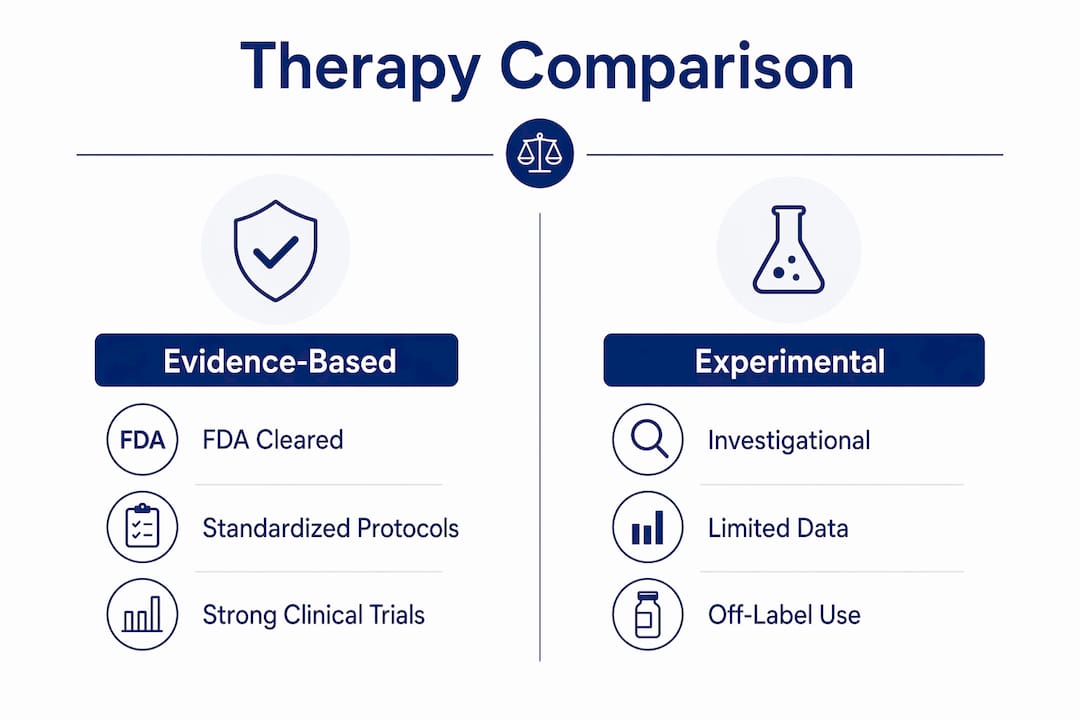
The line between evidence-based and experimental regenerative therapy is not always obvious, but it comes down to three factors: standardized preparation, documented dosing, and reproducible outcomes across patient populations.
Here is what separates a well-supported protocol from a variable one:
- Standardized preparation. PRP efficacy depends heavily on platelet concentration and leukocyte content. Proper standardization of PRP preparation is necessary to realize clinical benefit. Many commercial settings skip this step, which leads to inconsistent results that have nothing to do with the therapy itself.
- Documented dosing. Significant variability in dosing, activation, and preparation of PRP and stem cell treatments limits reproducibility in clinical practice. A provider who cannot tell you the platelet concentration in your injection is not following an evidence-based protocol.
- Reproducible outcomes. Evidence-based practice means the treatment has produced consistent results across multiple patients and studies, not just in one clinic or one trial.
Off-label use is not inherently wrong. Many effective treatments are used off-label in medicine. The concern arises when a therapy is marketed as proven without the data to support that claim, or when preparation quality is not controlled.
Pro Tip: Before your first treatment, ask your provider: “What is the platelet concentration in this preparation, and how was it measured?” A provider following evidence-based protocols will have a clear answer. If they cannot answer, that is a signal worth noting.
Understanding how to choose evidence-based treatments is one of the most practical steps you can take before committing to any biologic therapy.
Who is a good candidate for regenerative medicine therapies?
Patient selection is the factor most often overlooked in conversations about regenerative medicine. Patient stratification, meaning matching the right therapy to the right patient at the right stage of their condition, is more influential on outcomes than the choice of procedure alone.
Several factors determine candidacy:
- Condition type and severity. PRP performs well for mild to moderate osteoarthritis and tendinopathies like patellar tendinitis or lateral epicondylitis. Severe, end-stage joint degeneration may not respond as well, and surgical consultation may be more appropriate.
- Biological profile. Age, overall health, platelet activity, and inflammatory status all affect how well your body responds to biologic therapies. A thorough evaluation before treatment is not optional. It is the foundation of a sound plan.
- Stage of degeneration. Earlier intervention generally produces better outcomes. Patients who pursue regenerative therapy before reaching end-stage tissue damage tend to see more consistent improvement.
- Realistic expectations. Most patients see gradual improvement over 6–12 weeks following PRP treatment. Results are not immediate, and a single injection is rarely the complete answer. Many protocols involve a series of treatments combined with physical rehabilitation.
Combining biologics with rehabilitation may improve outcomes further, though the clinical evidence on this combination is still developing. What we see in practice is that patients who stay consistent with their rehab alongside biologic treatment tend to recover more fully than those who rely on the injection alone.
Many patients come in after trying cortisone shots, anti-inflammatory medications, or physical therapy without lasting relief. Regenerative therapies are not a last resort. They are a different category of treatment, one that works with your biology rather than masking symptoms. Understanding which therapy fits your condition is the starting point for any honest conversation about care.
Key Takeaways
Evidence-based regenerative medicine requires standardized protocols, proper patient selection, and therapy matched to condition stage to produce reliable, reproducible outcomes.
| Point | Details |
|---|---|
| Definition of the field | Regenerative medicine uses biologic agents like PRP and stem cells to stimulate the body’s own repair mechanisms without surgery. |
| Regulatory status varies | Viscosupplementation is FDA-cleared for knee OA; PRP and stem cell therapies are mostly off-label or investigational. |
| Evidence quality matters | Meta-analyses carry more weight than single trials; PRP shows an efficacy odds ratio of 1.4 in specific musculoskeletal uses. |
| Protocol standardization is critical | Platelet concentration, leukocyte content, and activation method directly determine PRP outcomes and must be documented. |
| Patient stratification drives results | Matching therapy type to condition stage and biological profile matters more than the procedure choice alone. |
What I have learned from watching patients navigate regenerative medicine
The most common misconception I see is that patients assume any clinic offering PRP or stem cell therapy is delivering the same product. That is not true, and the gap between a well-prepared biologic and a poorly prepared one can be the difference between meaningful improvement and no change at all.
What I have found is that patients who do best are the ones who ask hard questions before they start. They want to know what is in the injection, how it was prepared, and what the evidence says for their specific condition. That kind of engagement is not just reassuring for the provider. It is a sign that the patient is ready to be an active participant in their recovery, which matters.
The other thing worth saying plainly: regenerative medicine is not a cure for everything. It works best within a defined window of tissue damage, with the right preparation, and alongside appropriate rehabilitation. Patients who come in expecting one injection to reverse years of joint degeneration are going to be disappointed, and any provider who promises that outcome is not being honest with you.
What I believe in is transparency. The research on PRP and biologics is genuinely promising. The field is moving forward. But the honest version of that story includes the limitations, the protocol requirements, and the realistic timelines. That is the version worth telling.
— Felix
Regenerative medicine services at Nortextissueregeneration
Nortextissueregeneration offers PRP therapy and stem cell treatments for patients dealing with chronic joint pain, sports injuries, tendinopathies, and degenerative conditions throughout North Texas. Every treatment plan at Nortextissueregeneration follows standardized preparation protocols, with documented platelet concentrations and individualized dosing based on your condition and biological profile. We do not offer a one-size-fits-all approach because the evidence does not support one. If you are evaluating your options and want a clear, honest assessment of whether regenerative therapy fits your situation, a consultation with our clinical team is the right first step.
FAQ
What is the definition of regenerative medicine?
Regenerative medicine is a field of non-surgical therapies that use biologic agents, such as PRP and stem cells, to stimulate the body’s natural tissue repair processes. The four main treatment categories are viscosupplementation, prolotherapy, platelet-rich plasma, and cell-based therapies.
Is PRP therapy considered evidence-based?
PRP has strong meta-analytic support for conditions like osteoarthritis and tendinopathies, with studies showing a statistically significant efficacy advantage over controls. However, protocol variability across clinics means outcomes differ, and PRP remains off-label for most specific indications.
How does regenerative medicine differ from surgery?
Regenerative medicine works by introducing biologic agents that support the body’s own healing response, without cutting, removing, or replacing tissue. Surgery addresses structural problems mechanically; regenerative therapies address them biologically.
Why do some PRP treatments work better than others?
PRP outcomes depend directly on preparation quality, including platelet concentration, leukocyte content, and activation method. Clinics that do not standardize these parameters produce inconsistent results, which is why preparation protocols matter as much as the therapy itself.
Who is not a good candidate for regenerative therapy?
Patients with end-stage joint degeneration, active infection, certain blood disorders, or conditions requiring structural surgical repair may not be appropriate candidates. A thorough clinical evaluation is required before any biologic treatment to confirm suitability.